|
| [L] Charles Haynes [C] John Inazu [R] Yuval Levin at Religious Freedom Center 10/28/2016 [Photo BDMatt] |
 The Religious Freedom Center at the Newseum gathered six scholars from eclectic perspectives and ideologies to consider “Our Fractured Republic, Religious and Political Divides and the Role of Pluralism”. The keynote speaker for the forum was Dr. John Inazu, a professor of law and religion at Washington University in St Louis.
In a diverse nation, we must accept chaos, control or co-existence. Dr. Inazu postulated to achieve confident pluralism in America, we must protect the rights of assembly and association, facilitating civil dissent in public forums and not allow government orthodoxy to discriminate in funding. There seemed to be across the board agreement by the forum to these noble ends of confident pluralism.
The challenge seems to be inspiring a tolerance for differences in co-existence while respecting others and allowing for a space for difference. Tolerance along with humility and patience helps build a common ground without finding a common good. But this idyllic existence is mooted by the litigious manner in which contentious public policy is implemented.
Conservative commentator Yuval Levin lauded localism, which allows contending parties to put a face on their opposition and possibly find compromises. Yet most First Amendment controversies are pushed by outside forces and look to establish bright line rules which curtail the fundamental freedom of believers.
The panel seemed to agree that the Indiana Wedding Cake controversy could have been easily averted if LQBTQQ?? couple would have looked for a baker who did not object to participating in their nuptu\ial ceremony. However, this naively assumes that the homosexual activists were just looking for a baker instead of a target to test RFRA through litigation and to possibly hurt politicians who supported the Religious Freedom Act (such as Indiana Governor and Republican Vice Presidential nominee Mike Pence). To be fair, it was observed that the Indiana RFRA kerfluffle was used as a wedge issue by both sides.
 Another instance in which common sense could quash controversy concerns physicians who morally object to filling certain prescriptions. Clearly, what was meant is abortofacients, but the mere mention of contraception or abortion would wreck a spirit of compromise. With the caveat that another in-house pharmacist could fill the script without controversy or inconveniencing the customer, this would be a terrific compromise.
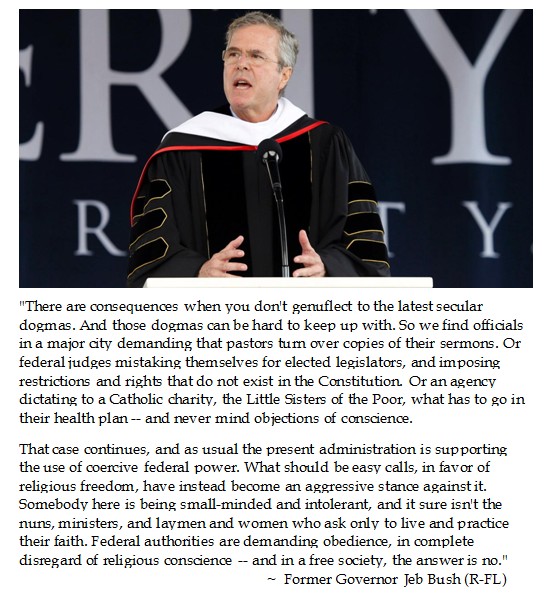
Alas, that is not generally the way things go in America nowadays. State licensing boards have demanded that doctors must be able to fill all prescriptions. Moreover, the HHS Mandate read into Obamacare almost deliberately picked a fight with the Little Sisters of the Poor to force them to violate their consciences to have contraception coverage. Thus, progressives have shown they value capitulation rather than compromise for religious liberty.
Dr. Charles Haynes, the founding director of the Religious Freedom Center, drew upon his decades of experience with First Amendment issues in public schools, contended that we are capable of finding pluralism but what we lack is trust. Perhaps, but this sense of optimism should be tempered by the autocratic manner in which the Department of Education is forcing implementation of transgender bathrooms in public schools, despite debate and locally achieved compromises. The same ukases can be applied to hot button religious liberty issues in which Washington threatens funding unless it it done the Feds way.

The assembled panel universally took umbrage to efforts to forestall an implementation of Sharia Law as being anti-Muslim Islamophobia. The manner in which there has been propaganda and suspicion cast against American Muslims was likened to the virulent anti-Catholicism of the 1850s No-Nothing Party. In fact, the parallel was extended as Catholics in the past were considered to support a foreign prince (i.e. The Pope) thus their loyalty to America was considered suspect. There was general assent to the idea that in 50 years, Muslims may just be considered another religious faction with conservative cultural predilections.
Of course, this sunny take ignores that Islam is a holistic system which merges worship with the body politic, particularly in places which it gains a significant minority or de facto majority status. In such circumstances, it becomes quite challenging to live a confident pluralism. This rosey take also is blithely unconcerned with the significant funding of mosques from Salafist sources. Furthermore, it dismisses polling of American Muslims which shows majorities agreeing with jihadist activities. But for this crowd, mentioning these inconvenient truths may make one a pariah in polite “educated” circles.
The ray of hope for confident pluralism was extolled in Utah. In 2015, Mormon church leaders worked with LGBTQQ? activists to pass a bill which banned homosexual discrimination in housing and employment, which protecting religious organization and their institutions and also included a “carve out” for people with conscience objections. It was hoped that the “Utah Compromise” could be a template for the rest of the nation.

It should be noted, however, that Utah has some special circumstances which may make it more of an outlier rather than a vanguard of confident pluralism. Utah is a small, relatively homogeneous state that is dominated by the Latter Day Saints Church. Mormons may be acutely aware of minority rights considering their tenuous status in much of the 1800s. While the spirit may be willing to act as a model, it may be impossible to replicate this cooperation elsewhere, especially when gadflies can wreck havoc on institutions and long accepted social norms, and when progressive power can dictate from bureaucracies, executive action and the courts.
While it was pleasant not to have an event in which public figures exchange insults like in Election 2016 debates, the general consensus of this Religious Freedom Center panel sometimes lacked a rigor on mediating profound differences. It seemed reminiscent of a United Council of Churches pronouncement which acceded to the same general vision, albeit via different paths. Considering that many of the hot button issues affecting religious liberty today are LGBTQQ?, gender equality, immigration and abortion, it is a pity that a Catholic scholar who represented the Magisterium (Catholic Church teachings) was not there to mix it up. There may have been some illuminating agreement as well as an opportunity to invoke compromise.