Showing posts with label Art. Show all posts

Friday, April 10, 2020

Sound the Strepitus

An Obituary and Eulogistic Meditation of Yeshua bar Yahosef bar Yaqub


The Strepitus is the sudden loud clatter that symbolizes how the Earth convulsed at the physical death of the only begotten Son of our Lord.   In Matthew 27:46-53, when Christ gave up His spirit on the Crucifix, there was a tumultuous earthquake.   It is the jarring closing of a Tenebae Service, which is done in preparation for the Paschal Triduum.


Some churches have the Tenebrae on Spy Wednesday.  Others choose to extinguish the lights after celebrating the Last Supper on Maundy Thursday or even Great and Holy Friday.  Regardless of the time, it is a ritual that reminds us of how the Light of the World was briefly extinguished to fulfill scripture as an expiation for mankind’s sinfulness.


While it is difficult to watch Mel Gibson’s cinematic masterpiece The Passion of the Christ (2004) for its depiction of the savage brutality inflicted by the Roman overlords on a political prisoner who challenged the religious practices and expectations of the Jewish hierachy.   The teardrop from heaven is incredibly moving.


When Salvador Dali painted Christ of Saint John of the Cross (1951), Jesus was depicted without wounds on a Cross that floated above the Earth. Dali listened to the color of his dream that indicated that depicting the nails, blood and crown of thorns would mar the image.  Dali wanted the emphasize the Trinity with the positioning of Jesus hanging on the Cross to represent the nucleus of the atom.  Clearly, the cross hovering over the Earth shows the cosmic significance of the passion and death of our Lord Jesus Christ. In a modern manner, Dali celebrates Eastern Christian Church's emphasis mystagogy of Jesus' Divine Sacrifice by death on the cross.


But during a Tenebrae service, the faithful were reminded that unlike even in classical depictions of Golgatha (the place of the skull) where Jesus was crucified, the crosses of Calvary were not necessarily hung that high in the air.  Since those being executed had their feet nailed bound to prevent them from moving as they slowly suffocated on their crosses, they may have been only a couple of feet above the ground.


Such crosses would serve the Roman overlords as tangible examples of what happens to brigands, rabble rousers and revolutionaries. The low positioning would allow most passers-by to look into the eyes of the executed. This makes the taunts from the crowd and Jesus’ words of forgiveness all the more remarkable.


It is easy to gloss over how the expiation of mans’ sins required a blood sacrifice to seal the New Covenant. By cognitively sounding the Strepitus over Christ's crucifixion, we may "Ecce homo".


While some ears may find it as painful as the Stepitus, the Christ’s Passion has been told by Glenn Beck using a motif of Pink Floyd’s Dark Side of the Moon  (1973).  Whether we use pop parables, cinematic accounts, scriptural studies, communal worship or prayerful personal reflections, it is worthy to reflect on how God's only begotten Son chose to be the suffering servant to right the relationship between God and mankind.


[This piece originally ran at DCBarroco.blogspot.com]

Thursday, February 22, 2018

Celebrating the Chair of St. Peter

Pope Benedict XVI on celebrating the Chair of St. Peter

It may seem a bit unusual that the Catholic Church celebrates the Feast of the Chair of St. Peter.  The feast which has been marked since the Fourth Century is more than , however, is more than a celebration about an ornamented seat  in the apse of St. Peter's Basilica at the Vatican.  It also represents the spiritual authority of the Church.  

The Church used to celebrate the Chair of St. Peter on January 18th and February 22nd. But in 1960, Pope St. John XXIII removed the January 18th feast, but the February 22nd date became a second class feast. 

Original Chair of St. Peter Woodcarving
Chair of St. Peter woodcarving, from Wood Carvings in English Churches (1910)


The wooden throne was a gift from Holy Roman Emperor Charles the Bald to Pope John VIII in 875. The original portion of Cathedra Petri is a plain oaken arm chair made of worm eaten wood. This chair has been cut in various spots, presumably for relics. During the Middle Ages, the Chair of St. Peter was displayed once a year as well  the sedi gestoria as when a newly elected Pope was enthroned. 

To preserve the precious relic for posterity, Pope Alexander VII encased the Chair of St. Peter into a bronze throne designed by Bernini, who augmented the Throne of Peter from 1647-1653.  The Chair of Peter is supported by statues of four doctors of the Church-- St. John Chrysostom and St. Athanasius from the East and St. Augustine and St. Ambrose from the West. Bernini's design seems to have the cathedra hover over the apse altar lit by a window with a dove (representing the Holy Spirit) and is surrounded with gilded glory sunrays and sculpted clouds.  On the frieze above the altar is the inscription "O pastor of the Church, you feed all Christ's lambs and sheep" in Latin and Greek.


In the first year of his pontificate, Pope Benedict XVI noted:

Celebrating the "Chair" of Peter, therefore, as we are doing today, means attributing a strong spiritual significance to it and recognizing it as a privileged sign of the love of God, the eternal Good Shepherd, who wanted to gather his whole Church and lead her on the path of salvation.

H/t: National Catholic Register 


Friday, February 2, 2018

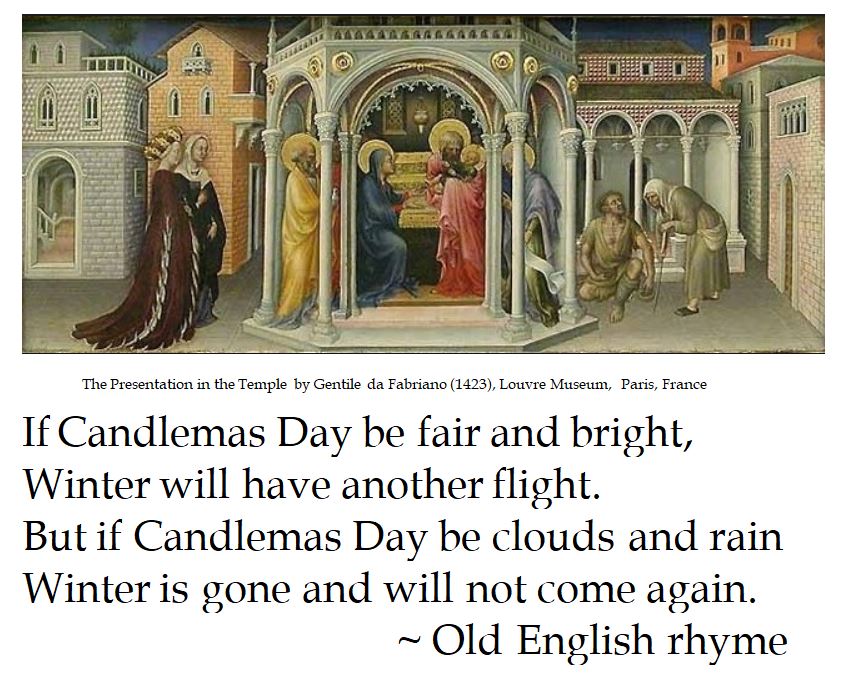
Connecting Candlemas to Groundhog Day

An old English rhyme celebrating Candlemas, the Presentation at the Temple of Jesus, the light of the world


February 2nd marks 40 days after Christmas.  On the liturgical calendar we celebrate the Presentation of Our Lord at the Temple, the traditional close of the Christmas season. It is also known as Candlemas, as the faithful traditionally processed into the church sanctuary with Candles. This ceremony re-presenting how the Mary and Joseph brought Jesus, the Light of the World, into the Temple.


On the secular calendar, we celebrate Groundhog Day, awaiting the predictions of Punxsutawney Phil from western Pennsylvania on whether there will be six more weeks of winter (not Black History Month as some wags have wondered).  This makes sense as it roughly is midwinter (especially prior to the Gregorian calendar adjustment of 1752).  Unbeknowst to most, Groudhog Day has a direct connection to Candlemas.

In eastern Europe, which focused on light and candles, there was a folk association between how much light was in the sky on Candlemas and God's providence in the months to come. Thus they believed that if there was a lot of light in the sky on February 2nd, there would be 40 more days of winter.  Germanic peoples used an animal as their light detector, typically a hedgehog or a badger.  When they immigrated to America, they adapted their instrument and used the plentiful groundhog. 

Monday, January 30, 2017

Honoring Jan Karski, the Messenger from Hell

Polish WWII Resistance Fighter Jan Karski on Democratic Societies


Today in a ceremony in Manhattan, academics posthumously honored longtime Georgetown University professor Jan Karski, a man who tried to prevent the Holocaust by sharing the truth. Alas, politicians among the Allies were tardy to act of the news from Karski as the Messenger from Hell.


During the Second World War,I Karski was a Second Lieutenant in the Krakow Valvary Brigade who was captured after the battle of Tomaszow  (1939) by the Russians. But due to Karski's birthplace, the Russians handed him over to the Germans, thus he avoided being a victim of the Katyn massacre of 1940. 

Karski escaped his German POW train in 1939 and escaped to Warsaw where he joined the Polish Resistance movement. Larslo  organized courier missions to the Polish Government in exile headquartered in Paris andhe himself made several secret trips to France and Britain. Karski was eventually captured by the Gestapo and tortured in Slovakia but was later smuggled out and rejoined the Polish Resistance. 

In 1942, Karski was selected by Polish Prime Minister in exile  WÅ‚adysÅ‚aw Sikorski to go on a secret mission to gather first hand information about the Nazi atrocities in occupied Poland.  Karski was smuggled into the Warsaw Ghetto. Karski also sought to infiltrate the Belzec death camp as an Estonian guard.  Although Karski only managed to see a transit station, the horror that he witnessed first hand was appalling.  

After briefing the Polish Government in exile upon his return to London in 1942, Karski met with other exiled Polish politicians and British Foreign Minister Anthony Eden about his first hand testimony about the Holocaust.  In June of 1943, Karski traveled to the United States to personally brief President Franklin Roosevelt, as well as other American civic and government leaders, including Secretary of State Cordell Hull and Associate Supreme Court Justice Felix Frankfurter, without much effect. Karski published his recollections Courier from Poland: The Story of a Secret State (1944) which sold more than 400,000 copies. 

Eventually Jan Karski settled at Georgetown University, eventually earning a Ph.D in 1952 and taught there for over forty years. Georgetown remembers Jan Karski as many things — a beloved professor, writer, and colleague, to name a few — but to the world, he was known as one of the first to warn Western powers of the horrors of the Holocaust.

Jan Karski at Yad Vashem (circa 1982)
Although Karski was a Roman Catholic, he felt a profound connection with the people whose lives he attempted to save from the Holocaust.  In 1981, Karski said: “All murdered Jews became my family. I am a Christian Jew.” In 1982 Karski was recognized by Yad Vashem as Righteous Among the Nations.  

In 1991, he received the Wallenberg Medal from the University of Michigan for his outstanding humanitarian efforts.  In 2012, President Barack Obama posthumously awarded Jan Karski the Presidential Medal of Freedom for his heroic witness to the ugly truth of the Holocaust.  Mr. Obama proclaimed: "Jan Karski -- a young Polish Catholic -- who witnessed Jews being put on cattle cars, who saw the killings, and who told the truth, all the way to President Roosevelt himself."   

"Whoever does not condemn, consents" mural in Warsaw

Karski's faithful witness has been remembered from murals in Warsaw to a series of five bronzes of Karski sitting on a bench playing chess created by Krakow sculptor Karol Badyna which are located in Georgetown, Manhattan, Lodz, Warsaw, Keilce and Tel Aviv University in Israel. 

Monday, January 9, 2017

Henry Wadsworth Longfellow on the Three Kings


Three Kings came riding from far away,
Melchior and Gaspar and Baltasar;
Three Wise Men out of the East were they,
And they travelled by night and they slept by day,
For their guide was a beautiful, wonderful star.

The star was so beautiful, large and clear,
That all the other stars of the sky
Became a white mist in the atmosphere,
And by this they knew that the coming was near
Of the Prince foretold in the prophecy.

Three caskets they bore on their saddle-bows,
Three caskets of gold with golden keys;
Their robes were of crimson silk with rows
Of bells and pomegranates and furbelows,
Their turbans like blossoming almond-trees.

And so the Three Kings rode into the West,
Through the dusk of the night, over hill and dell,
And sometimes they nodded with beard on breast,
And sometimes talked, as they paused to rest,
With the people they met at some wayside well.

"Of the child that is born," said Baltasar,
"Good people, I pray you, tell us the news;
For we in the East have seen his star,
And have ridden fast, and have ridden far,
To find and worship the King of the Jews."

And the people answered, "You ask in vain;
We know of no King but Herod the Great!"
They thought the Wise Men were men insane,
As they spurred their horses across the plain,
Like riders in haste, who cannot wait.

And when they came to Jerusalem,
Herod the Great, who had heard this thing,
Sent for the Wise Men and questioned them;
And said, "Go down unto Bethlehem,
And bring me tidings of this new king."

So they rode away; and the star stood still,
The only one in the grey of morn;
Yes, it stopped --it stood still of its own free will,
Right over Bethlehem on the hill,
The city of David, where Christ was born.

And the Three Kings rode through the gate and the guard,
Through the silent street, till their horses turned
And neighed as they entered the great inn-yard;
But the windows were closed, and the doors were barred,
And only a light in the stable burned.


And cradled there in the scented hay,
In the air made sweet by the breath of kine,
The little child in the manger lay,
The child, that would be king one day
Of a kingdom not human, but divine.

His mother Mary of Nazareth
Sat watching beside his place of rest,
Watching the even flow of his breath,
For the joy of life and the terror of death
Were mingled together in her breast.

They laid their offerings at his feet:
The gold was their tribute to a King,
The frankincense, with its odor sweet,
Was for the Priest, the Paraclete,
The myrrh for the body's burying.


And the mother wondered and bowed her head,
And sat as still as a statue of stone,
Her heart was troubled yet comforted,
Remembering what the Angel had said
Of an endless reign and of David's throne.

Then the Kings rode out of the city gate,
With a clatter of hoofs in proud array;
But they went not back to Herod the Great,
For they knew his malice and feared his hate,

And returned to their homes by another way.
                       
                               ~ Henry Wadsworth Longfellow 


Wednesday, September 14, 2016

Roodmas Reflections Through the Prism of Merciful Love


The Feast of the Exaltation of the Holy Cross (also known as Roodmas) is a solemnity which celebrates three distinct historical events: the finding of the True Cross by St. Helena, the retrieval of the sacred relic by Emperor Heraclius in 629 from the Persians and the ineffable powers of the instrument of Christ's redemptive sacrifice and our salvation. 

According to the Brevery, the Emperor Heraclius carried the Cross back to Jerusalem on his shoulders as he was garbed in fancy garments adorned with precious stones.  But at the entrance to Mount Calvary, the Emperor could not carry the Holy Cross up.  The bishop said to the astonished Heraclius:  

"Consider, O Emperor, that with these triumphal ornaments you are far from resembling Jesus carrying His Cross." The Emperor then put on a penitential garb and continued the journey.
This offers a lesson of humble service which fits into the lesson of Merciful Love associated with the Holy Cross .


The Church exalted the Holy Cross just as Moses lifted up the Bronze Serpent in Exodus and those who looked upon it lived. Jesus willingly sacrificed Himself so that we all may enjoy eternal life. 


In the early 20th Century, Sister Maria Teresa Desandais was blessed with mystical experiences about Jesus' Merciful Love. She wrote about these experiences under the pseudonym  "Sulamitis PM".  In 1912, Sr. Desandais, who had no training in painting, was inspired to create the picture "Merciful Love" which depicted Christ crucified looking towards heaven with a host in the background with the initials JHS.  Rays of light emanating from the Sacred Heart of  Jesus illuminate a  Bible laying at the foot of the cross turned to the passage "Love one another as I have loved you" alongside a crown.  That is an incredible amount of symbolic meaning suffused in one scene, particularly for an amateur painter. 

Sister Maria Teresa Desandais on Merciful Love


This message of Merciful Love was widespread in France and Spain after the First World War. To bolster devotion to Merciful Love, Sr. Desandais sent two of her paintings to Spain.  The painting sent to Juana Lacasa effectively became a place of pilgrimage. The other painting was installed at the Royal Basilica of Our Lady of Atocha in Madrid where Sister Maria Teresa's order was attached.

 It is quite conceivable that the message of Merciful Love of Jesus with the exhortation to be servants who love one another may well have influenced Pope Francis for the Year of Divine Mercy.

Part of Sister Maria Teresa's revelations was an offering to Merciful Love:

Holy Father, through the Immaculate Heart of Mary, I offer to you Jesus, your beloved Son, and I offer myself in Him and through Him, and with Him for all your intentions, and on behalf of all creatures.


Monday, August 8, 2016

St. Dominic on Prayer

St. Dominic on Prayer


 As the Church celebrates the Solemnity of St. Dominic, it is worth remembering that this year is the 800th anniversary of the founding of the Order of Preachers (a.k.a. the Dominicans).


Thursday, March 24, 2016

Artistic Impressions of the Agony in the Garden

Agony in the Garden, studios of El Greco (c. 1590s), National Gallery of Art, London UK 

Could ye not stay awake with me an hour,
You who by your consent would die for me?
Could you not stay awake with me one hour?
Look!
Judas--do not not see how he does not sleep,
But hastens to hand me over to the Jews?
Why are you sleeping?
Arise, and pray,
Lest you fall into tempetation.
Judas--Look!
       ~Sept répons des ténébres (1962)
         Francis Poulenc 


Monday, December 28, 2015

Commemorating Childermas


Say, ye celestial guards, who wait
In Bethlehem, round the Saviour's palace gate,
Say, who are these on golden wings,
That hover o'er the new-born King of kings,
Their palms and garlands telling plain
That they are of the glorious martyr-train,
Next to yourselves ordained to praise
His Name, and brighten as on Him they gaze?

But where their spoils and trophies? where
The glorious dint a martyr's shield should bear?
How chance no cheek among them wears
The deep-worn trace of penitential tears,
But all is bright and smiling love,
As if, fresh-borne from Eden's happy grove,
They had flown here, their King to see,
Nor ever had been heirs of dark mortality?

Ask, and some angel will reply,
"These, like yourselves, were born to sin and die,
But ere the poison root was grown,
God set His seal, and marked them for His own.
Baptised its blood for Jesus' sake,
Now underneath the Cross their bed they make,
Not to be scared from that sure rest
By frightened mother's shriek, or warrior's waving crest."

Mindful of these, the firstfruits sweet
Borne by this suffering Church her Lord to greet;
Blessed Jesus ever loved to trace
The "innocent brightness" of an infant's face.
He raised them in His holy arms,
He blessed them from the world and all its harms:
Heirs though they were of sin and shame,
He blessed them in his own and in his Father's Name.

Then, as each fond unconscious child
On the everlasting Parent sweetly smiled
(Like infants sporting on the shore,
That tremble not at Ocean's boundless roar),
Were they not present to Thy thought,
All souls, that in their cradles Thou hast bought?
But chiefly these, who died for Thee,
That Thou might'st live for them a sadder death to see.

And next to these, Thy gracious word
Was as a pledge of benediction stored
For Christian mothers, while they moan
Their treasured hopes, just born, baptised, and gone.
Oh, joy for Rachel's broken heart!
She and her babes shall meet no more to part;
So dear to Christ her pious haste
To trust them in His arms for ever safe embraced.

She dares not grudge to leave them there,
Where to behold them was her heart's first prayer;
She dares not grieve--but she must weep,
As her pale placid martyr sinks to sleep,
Teaching so well and silently
How at the shepherd's call the lamb should die:
How happier far than life the end
Of souls that infant-like beneath their burthen bend.


It is easy to be so absorbed in the joy of Christmas to forget some of suffering and turmoil that was associated with the miracle of the Incarnation.

Childermas, or the Feast of the Holy Innocents, commemorates the massacre of all males under the age of two in Bethlehem ordered by Herod to preclude a rival king.

The Coventry Carol is a haunting hymn which mourns the loss of the first Christian martyrs in the form of a lullaby to the Holy Innocents. 

Thursday, August 27, 2015

Galileo Galilei on Heaven

Galileo Galilei on Heaven


Post  Scriptus-Thanks to "The Curt Jester" Jeff Miller, who pointed out that Galileo was quoting Cardinal Caesar Baronius when writing to a duchess. 

Thursday, April 23, 2015

Justifying Georgemas


British Great War Recruiting Poster 

According to the Gregorian calendar, April 23rd is the Feast of St. George (or Georgemas).  The Orthodox also admire the attributes of St. George but follow the Julian calendar which marks the feast on May 6th.  St. George born in Syria Palestrinia in the late Third Century who served as an officer in the Roman army that guarded the Emporer Diocletian, but who was martyred for not renouncing his Christian faith.  The emperor tried to bribe George to renounce his faith and tortured him, but to no avail. Before he was decapitated, St. George gave all of his wealth to the poor.

St. George is one of the most venerated saints in the Catholic Church, among Anglicans, Orthodox, East Syrian churches. Even Muslims revere this honorable military man. In the Twelfth Century a legend was attached to St. George about slaying a dragon.  The standard Orthodox icon of St. George depicts him slaying a dragon with a woman in the background.


The dragon is generally understood as being both Satan and the monster from his own life (Diocletian). The woman in the background is Alexandra, the wife of Emperor Diocletian. Crusaders credit an appearance of St. George. This was probably legend which traveled back with the Crusaders from the Holy Land and was embellished in courtly Romance retellings.


Legend has it that a plague bearing dragon came down from the mountains and terrorized the countryside.  The dragon could not be appeased with ransom of livestock.  This  dragon would not stop his rampage unless the King tied a young maiden to an oak tree in the center of the village.

The King's nobles used a pigeon to decide what to do.  If the bird flew to the east then, they must take the King's own daughter Sabra and tie her to a tree, as the dragon demanded.  The pigeon flew off to the east. As the knight rode back in triumph with the princess

But as fate would have it, the pigeon managed  to attract the attention of a knight called  George and guided him back to the princess. Just as the dragon was about to devour the princess, the good knight clad in armor fortified himself with a sign of the cross and then brought the fight to the dragon.  George cunningly slowed down the dragon by driving a ball of pitch down his throat, and then speared the dragon with a grievous wound with his lance.

The Wedding of St. George and Princess Sabra by Dante Gabriel Rossetti (1857)


According to Eastern versions, the knight rode back to the city along with the princess and the dragon in tow.  As George approached the city, he promised to slay the dragon if the town would become baptized Christians.  Fifteen thousand men took to the baptismal waters and George slayed the dragon with his trusty sword Ascalon (recalling the city Ashkelon in Israel).  The king was so grateful that he bestowed nobility (some say Sainthood) to George and gave his daughter Sabra's hand in marriage and promised to build a church were the dragon was slain.

St. George is the patron saint of England yet it is not a public holiday in England. The reasons why celebration of Georgemas is muted are cultural, historical and now tinged with political correctness.


St. George was neither English nor roundly associated with England, even though King Edward III formed the Order of the Garder under the patronage of St. George in 1348.  The Reformation played a part as Protestants did not care much for saints' days. In addition, celebration of St. George's day has been in decline since the Act of Union between England in Scotland completed in 1707.  In today's world,  the Daily Telegraph reports that many English people are concerned that national symbols like St. George can be considered racists,


Aside from the fact that many pubs in England are named after George and the dragon, it makes one wonder why this legend matters. Modern man is quick to dismiss myths (unless it is anthropogenic global warming), but this is short sighted. Myths convey essential truths although the romantic story elements may not be exact.  For instance, the story of George Washington chopping down the cherry tree may have been apocryphal but it does "I can not tell a lie" does illustrate some of the virtues of Washington's transcription of "The Rules of Civility and Decent Behavior", which molded the first President's life and were put into practice at the founding of the American Republic.

The reason that St. George matters so much to the English is that the legend reinforces characteristics which the English admire and seek to emulate.  St. George is a knight who exemplified chivalry. St. George and the dragon also champions the little guy as well as the triumph of good over evil.  The versions which depict him making the sign of the cross depict deep dedication to principles (if we dare not declare faith).  These romanticized virtues along with the more verifiable versions of his hagiography make St. George a man worthy (bank holiday or not) for Englishmen to emulate.