Showing posts with label Benedict XVI. Show all posts

Wednesday, April 28, 2021

Contrasting Low Mass Expectations with Aggiornamento Aspirations


Recently, when an old friend was visiting the area, I agreed to go to a Traditional Latin Mass with him.  While I firmly agree the Pope Benedict's motu propio Summorum Pontificum (2007) which confirmed the licitity a Tridentine Mass, my prior experiences, particularly of Low Masses, had not fed my soul.  Alas, this particular Extraordinary Form of the Sacrifice of the Holy Mass also lived up to my Low Mass expectations.  So many traditionalists gush about about the Mass of Pope (St.) Pius V.  As I appreciate history and I love languages, I am not intimidated by the Usus Antiquior.  Moreover, I was prepared to occasionally being lost in the mystery of liturgical worship.  With all of that in mind, so many elements of the Missa Privata left me cold.

Granted, I am a child of Vatican II who appreciates worshiping in the vernacular. However, I can see the beauty of centuries of tradition contained in the Traditional Mass.  I appreciate the silent reverence of the People of God when inside the sanctuary.  This solemnity is also reflected by communicants at the altar rail (made more tolerable by padding at the edge of the marble altar). Yet is seems that the Low Mass in the Extraordinary Form seems to lack the full, conscious and active participation of the faithful which was envisioned from the Vatican II constitution Sacrosanctum Concilium (1963).

Radical Traditionalists (“Rad Trads”) will insist that only the Old Mass is legitimate and ought no be changed.  This is echoed in the motto Semper Idem (“Always the Same”)  of Cardinal Ottaviani, a leading proponent of the Usus Antiquior during Vatican II. Such a train of thought convicts some like the Priestly Society of Pius X (SSPX), to reject all of Vatican II.  This leads some to to adhere to sedevacantism (believing that the Chair of St. Peter has been empty since 1958).  “Mad Trads” still have papal  allegiance  but chauvinistically believe that the 1962 Mass  is superior worshiping than the 1969 Novus Ordo Mass of Pope (St.)  Paul VI.   

“Glad Trads”, like Scott Hahn and Matt Fradd, joyfully embrace the Extraordinary Form of the liturgy.  Glad Trads may hope that that elements of the Traditional Mass may make it back into the Novus Ordo (echoing the hopes of Pope emeritus Benedict XVI). 

Alas,  that seems unlikely given the recent row at the Vatican prohibiting side altar Masses at St. Peter’s Basilica.  This questionably issued procedure relegates the Traditional Latin Mass to the intimate grotto St. Clementine Chapel.  Many appreciate this move as another example of the ever simmering Liturgy Wars which seems to suppress the licit Extraordinary Form which is skeptical about the patrimony of so called “Mass of the Ages”.  More poignantly, Fr. Tom Reese recently suggested that young people should be prohibited from attending the Traditional Latin Mass. 

While I am unaccustomed to the practice, I appreciate the ad orientem orientation of the priest celebrant on the altar in the Traditional Latin Mass, as the whole congregation ought to be facing liturgical East when worshiping.  


But the brief gestures towards the congregation of
"Oremus" struck me as pro forma and almost gratuitous as he recited the Divine Liturgy.  For me, as the old Low Mass progressed, the silence became deafening.  It seems logical that the cleric would lead on the propers portion of worship, but there seemed to be no opportunity for the congregation to participate in prayers at a Low Mass, aside from the Agnus Dei and the prayer of Divine Access ("Lord I am not worthy").   The faithful recited more prayers verbally at the foot of the altar after mass ended than during the actual liturgy. 

When the third translation of the Roman Missal was promulgated in English speaking countries in 2011, a big deal was made over the linguist change of  "I believe" being said during the Nicean Creed in the Ordinary Form of the Mass rather than using a communal voice.  In this Low Mass, the Priest definitely said "Credo" but no one else, even my Latin fluent friend, joined in. So much for a personal creed.

 There was also communal silence beyond the altar during the Pater Noster, the perfect prayer which Jesus taught His believers to say.  The congregation mostly sat there quietly, with some praying a rosary during Mass. Not only is the Lord’s Prayer a unifying prayer throughout Christendom, but if we deeply reflect on its tenants, it challenges our practice of faith.  But when the “Our Father”  is said sotto voce from a celebrant on the High Altar during a Low Mass, it risks becoming a mere ritual.

These observations highlight the philosophical difference  between the Tridentine and Novus Ordo Mass.    The Old Form emphasizes humanity's sinfulness and unworthiness save the grace of Christ dying on the Cross at Calvary.  The Novus Ordo seems to have a more communal narrative, focusing on the institution of the Eucharist. This re-presentation of the Last Supper feeds the communicant's soul and is made more profound by active participation in the Liturgies of the Mass.  

Some Protestants bristle at the Sacrifice of the Mass. They  mistakenly believe that Catholics re- crucify our Savior during the Liturgy instead of appreciating that we celebrate the new Passover when Jesus freely gave his Body and Blood during the Last Supper to forgive our sins and nourish the faithful via the Eucharist (i.e. Communion).  This is made more evident by emphasizing the Lord's Supper in the Novus Ordo.

Another sticking point for me of the Extraordinary Form was how the Liturgy of the Word is conducted.  Traditionalists will suggest that we should be adhering to the original language of Latin, yet the history is a little more complicated. While the Roman Church is steeped in its Latin tradition, the Mass originated in Aramaic  and Greek (which was the lingua franca of the Roman Empire until Latin became the language of liturgy).  This shows some evolution of worship and proclaiming the Good News in the vernacular.  Citing lex orendi, lex credendi, I can appreciate having the ordinary portions of the Traditional Mass being recited in Latin.  However, what good is proclaiming scripture in Latin when it has to be repeated in a rushed reading before announcements and the sermon?

At the Low Mass, I missed having the Old Testament proclaimed.  In the New Mass, the first reading from the Old Testament reminds us of God's love affair for His people and it usually gives dimension to the Gospel reading with which it is paired. This practice makes typology more evident to those faithful in the pews. Without that connection with the Hebrew Scripture, it misses out on the depth of God's love letter to his "very good" creation and adopted children in scripture.  Moreover, it can further the division between followers of "The Way" with God's chosen people fostering an unfortunate lingering veneer  anti-Semitism. 

 During the Easter season, Novus Ordo Masses are blessed with readings from the Acts of the Apostles, to appreciate how the early Church lived out the Good News of Jesus Christ’s sacrificial death, resurrection and ascension. Since there was only the Epistle and the Gospel, an E.F. homily runs the risk of being a quick restatement of the reading or an opportunity for an unrelated doctrinal sermon. 

Prior to Vatican II, there was not a three year Lectionary in which the bulk of Salvation history is proclaimed from the ambo, but a non-rotating one year cycle.  In the Old Mass, daily mass readings either echoed the prior Sunday or the Saints day or Ember days.  I greatly appreciate the liturgical cycle from Vatican II, as we revisit scriptural readings every few years.  This cycle of scriptural readings allows an attentive Mass goer an opportunity to listen to a familiar scripture and process it with some life experience or hearing a parable with different emphases rather than tuning out a too familiar yearly text.  

My traditionally oriented friend lamented with all of the options for Eucharistic Canons and prayers that it threatens the unity of the Catholic church.  Of course, this ignores that Catholicism has 24 particular churches, along with Ordinariates. Even the Roman Catholic church has historically had different rites, some of which remain to this day, such as the Ambrosian in Milan (Italy) the Mozarabic in Toledo (Spain)  and the Braga rite in Portugal.   In fact, then Cardinal Joseph Ratzinger cited the Braga rite in 1998 to show that variety in the Latin Church demonstrates that unity does not require liturgical uniformity.

To allay my objections to the laity's passive role in the Traditional Latin Mass, a parable about active participation was proposed.  I was asked to consider an atheistic boyfriend being dragged to Mass each week by a pious Catholic girlfriend.  After a while, the atheist learns the proper responses (presumably in the vernacular Novus Ordo Mass) and recites them without truly believing them.  Then there is Mrs. McGillicuddy, who cannot hear the quietly uttered Extraordinary Form prayers, much less understand them in Latin, but who uses the reverential silence in the Mass to pray the Rosary.  

The dialectical question posed from this pious parable is who is actively participating? Parables are succinct didactic stories to illustrate a deeper point, but often they have the effect off making a listener feel uncomfortable as one can sympathize with both viewpoints.   A traditionalist is inclined to believe that the active participant is Mrs. McGillicuddy who is reverently praying.  Granted, she is piously praying and doing the best that she can.  But Mrs. McGillicuddy was praying a personal prayer rather than actively uniting herself to the Liturgy (public worship).  On the other hand, the atheistic boyfriend lacks faith but he is participating in the public worship of the Church.  Granted, these prayer recitation may remain as a ritual to ingratiate himself to his girlfriend. But this active participation in the liturgy may create an opening for a moment of grace to inspire a metanoia which inspires faith. I have heard enough stories of how the Holy Spirit can break down barriers to those attentive to Catholic Church liturgies, from Satanists (Zachary King) to Presbyterians (Scott Hahn)

Seeking direction from Sacrosantum Conciliam, the laity are extolled to not be silent spectators but they should take part in the sacred action conscious of what they are doing with full devotion and collaboration (para. 48).  In fact, in communion the faithful are not just nourished by the hands of the priest in the Eucharist but are urged to offer themselves through Christ our Mediator.  This echoes the pious practice of "offering up" your tribulations during the consecration as taught in the Baltimore Catechism.  This is hard to do if one can not follow the Liturgy due to language and amplification, thus one opts to use the sacred time to rattle off a rosary.

Traditionalists bristle at the infiltration of Modernism in the Catholic Church.  Many look askance at the products of the Second Vatican Council, and champion skeptics like Archbishop LeFavre.  But LeFevre voted for all sixteen documents of Vatican II in the mid 1960s, ten years later rejected them in "I Accuse the Council" (1976).


Later in 1981 LeFevre accepted Vatican II in the light of tradition and then recanted.  LeFebvre was not exactly a rock of faith, but he  was a bishop that  prized the faith and tradition of the old Latin Mass. Thus LeFevre  had concerns with the implementation in the Spirit of Vatican II, which often barred little resemblance to the documents of the Council.

It is understandable to balk at what Bishop Robert Barron calls the Banners and Balloons Beige  Catholicism from wild and wooly Catechism of the 1970s (some may compare it to the Rolling Stones compilation album "Sucking in the Seventies").  

Then there was the improv license which some priests took from the dynamic translation of the Second Translation of the Roman Missal making them the center of secular attention. The renovations (a.k.a. “wreckifications”) of many churches during this period smacks of Modernism.  But these excesses do not negate the "aggionamento" aspirations of Vatican II to encourage full and active participation in the Mass and dialog with the outside world.

Personally, I am happy to see implementation of the Hermaneutic of Continuity in some parishes, in which some portions of the Mass which  contain Latin and Greek have been integrated into response that the laity actively participate.  When followed, the new Missal abates many of the liturgical abuse associated with the Spirit of Vatican II.  In accompanying Catechumens into the Church, I can appreciate how they are drawn to the Real Presence of Jesus in the Eucharist as emphasized through the recapitulation of the Last Supper.   Prior to the Coronavirus 19 pandemic, the Church was scandalized by polls showing the dearth of belief by American Catholics in the  Real Presence in the Eucharist.  As Churches again resume normal liturgy, we will see if the faithful will return to Mass and if they hunger for the Body, Blood, Soul and Divinity contained in Communion. 

I also welcome Glad Trads who faithfully reverence the Traditional Latin Mass.  Even though my several experiences with the Low Mass have been uninspiring, I appreciate the beauty and history of the Missa Cantata.  Moreover, the regality of the Papal Traditional Latin Mass is awe inspiring.  May they continue to be spiritually nourished in celebrating "The Mass of the Ages".  

That being said, I am put off when “Frozen Chosen” proponents of the Traditional Latin Mass deride the Novus Ordo as a "Man Made Mass" or imply that it is inherently inferior.  Often they tout the history of the liturgy, which is undeniable.  They will allude to the reverence, which is also quite evident.  They point to the beauty, which from my perspective can be diminished by a lackluster Low Mass in which the priest silently does everything.   What I find it lacking is fully conscious and active participation by all.  As a layperson, I lack the faculties to confect the Eucharist, but my baptism makes me part of the ordinary priesthood which should not be effectively sidelined in the Holy Mass, which is considered to be the source and summit of our Faith.

I have found most elements of the Traditional Latin Mass liturgy paired with the vernacular language and active participation by the faithful at Masses in the Anglican Ordinariate, also made possible by Pope Benedict XVI’s moto propio Anglicanorum Coetibus (2009).  But it can be hard to find parishes with the Anglican Patrimony which swam the Tiber and rejoined Mother Church. 

It is my hope that Catholics can appreciate the faith that unites us in Christ, understand that this religiosity may rightly be expressed in various manners and that we can be strengthened in faith with the plurality of pieties.  Not everything which emanated from the Second Vatican Council was bad, though some of the latter documents (1964-65) suffered from the ambiguity of trying to reach 90% consensus.  However, not every innovation said to be done in the “Spirit of Vatican II” was good. And it was lamentable how some citing the direction of the “Spirit of Vatican II” unmethodically discarded what they believed were dated liturgical practices and Catholic Culture.

Now that we have had over a half a century to digest implement and reconsider Vatican II, we ought to be able to discern the goods from the pastoral council and reconsider unanticipated liturgical mistakes and excesses. On the one hand, those in authority in the Church ought to quit trying to stifle licit and legitimate traditional forms of the liturgy, and be responsive to some of the younger faithful who are drawn to the reverence of the Traditional Latin Mass. On the other hand, the TLM faithful need to drop the sub rosa Liturgy War superciliousness and chauvinism which are premised on the notion that their form of liturgy is the only right rite.  No doubt that some “innovations” seem ill advised or perhaps even heterodoxical.  But we should appreciate that much like differences in the Gospel or the practice of our many rites, the form may be slightly different as it highlights different aspects of our one true Catholic faith.


Thursday, February 22, 2018

Celebrating the Chair of St. Peter

Pope Benedict XVI on celebrating the Chair of St. Peter

It may seem a bit unusual that the Catholic Church celebrates the Feast of the Chair of St. Peter.  The feast which has been marked since the Fourth Century is more than , however, is more than a celebration about an ornamented seat  in the apse of St. Peter's Basilica at the Vatican.  It also represents the spiritual authority of the Church.  

The Church used to celebrate the Chair of St. Peter on January 18th and February 22nd. But in 1960, Pope St. John XXIII removed the January 18th feast, but the February 22nd date became a second class feast. 

Original Chair of St. Peter Woodcarving
Chair of St. Peter woodcarving, from Wood Carvings in English Churches (1910)


The wooden throne was a gift from Holy Roman Emperor Charles the Bald to Pope John VIII in 875. The original portion of Cathedra Petri is a plain oaken arm chair made of worm eaten wood. This chair has been cut in various spots, presumably for relics. During the Middle Ages, the Chair of St. Peter was displayed once a year as well  the sedi gestoria as when a newly elected Pope was enthroned. 

To preserve the precious relic for posterity, Pope Alexander VII encased the Chair of St. Peter into a bronze throne designed by Bernini, who augmented the Throne of Peter from 1647-1653.  The Chair of Peter is supported by statues of four doctors of the Church-- St. John Chrysostom and St. Athanasius from the East and St. Augustine and St. Ambrose from the West. Bernini's design seems to have the cathedra hover over the apse altar lit by a window with a dove (representing the Holy Spirit) and is surrounded with gilded glory sunrays and sculpted clouds.  On the frieze above the altar is the inscription "O pastor of the Church, you feed all Christ's lambs and sheep" in Latin and Greek.


In the first year of his pontificate, Pope Benedict XVI noted:

Celebrating the "Chair" of Peter, therefore, as we are doing today, means attributing a strong spiritual significance to it and recognizing it as a privileged sign of the love of God, the eternal Good Shepherd, who wanted to gather his whole Church and lead her on the path of salvation.

H/t: National Catholic Register 


Thursday, November 16, 2017

On Pope Francis on Pre-Mass Silence and Lex Vivendi

Pope Francis on Pre Mass Silence


Recently, Pope Francis lamented the tendency of Catholics to engage in small talk before Mass when they ought to be spiritually preparing for the liturgy.

This may be related to how the Mass is considered by the faithful.  The Council of Trent affirmed the holy sacrifice of the Mass.  The spirit of Vatican II considers it a family meal, thus what would be wrong with some pre-supper conversation?

While it is laudable to have pre-liturgical silence to encourage the People of God to prepare for the Liturgies of the Word and the Eucharist, it should be tempered by fostering community.

It is my experience that at least in America, parishes are no longer the tightly knit and stable discreet communities that they once were.  Folks typically move around.  There are volitional parishes where people choose to attend.  People often do not make a day of worship, sticking around for coffee or pot luck.

The infrastructure can also be an issue.  My parish's main church was built in the 1850s and has a very small narthex, so there is not a courtyard for people to gather and make small talk before going into the sanctuary.  Many modern churches have incorporated a gathering area for such purposes.

So what would be the best way to cultivate more reverence prior to Mass?  I would suggest catechesis and clues.

While I want thoughtful exegesis from a homily, it can sometimes be edifying to also have some instruction.  I regret that I did not hear more priestly presiders educate the faithful about the change from dynamic translation to static translation of the new Roman Missal in 2011.  I sought to educate myself and attended some additional talks which helped me understand the logic of the syntax changes as well as to become accustomed to the "clunky" new sound.

Pope Benedict XVI observed that the essence of liturgy disappears when we applaud in church and it becomes religious entertainment.  While the Mass that I frequently attend has a wonderful contemporary choir,  it still garners applause "from the crowd" after Mass.  Being shepherded by our Holy Father, I curbed my enthusiasm for post-prandial celebration.  It would have been instructive if clergy discerned if such a critique was praiseworthy and shared it with their flock.

Another moment where reverence not revelry ought to be instructed is during the "sign of peace". In some liturgies, it becomes a "half time" where people will briefly socialize with their neighbors.  Some celebrants campaign, needing to shake the hand of every Catholic "constituent".    Liturgically, we are sharing the unity coming from the altar after the fraction rite that comes sharing one body of Christ. So several years ago, the Congregation for the Divine Worship  published a piece which discouraged irrational exuberance during the sign of peace.  Yet this instruction received nary a mention from the pulpit.

One parish which I attend while visiting relatives has a barn-like sanctuary.  Several minutes before they start they dim the lights to get the People of God in the mood. Visually, they are giving them a clue.  Where I believe that they go off the right path in making announcements or having brief secular speakers come up front "before the show". 

For me, good liturgy is key.  However, community is also important.  There is probably not a one-size-fits-all approach.  But pastors and sacristans can discern what will work best for their "faith community".  And homilists ought not to be afraid to challenge their congregation to  prayerfully consider how we comport ourselves in the sanctuary before, during and after our liturgies.  And may the clergy not dismiss righteous chaffing from the faithful just because they are in charge. 

Friday, May 12, 2017

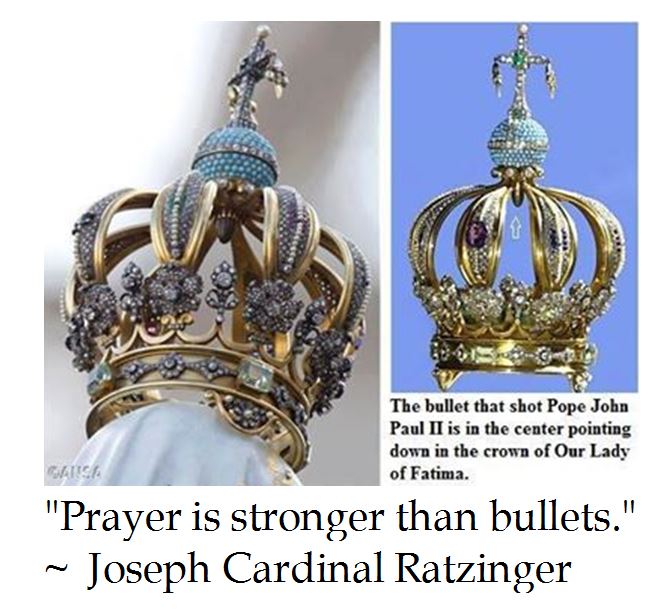
Cardinal Joseph Ratzinger on Prayer

Joseph Cardinal Ratzinger, the future Pope Benedict XVII, on Prayer
Pope St. John Paul II was so convicted that the Blessed Virgin Marry saved his life as the first apparition of the lady in white was on May 13th 1917 and he was shot on May 13th 1981. One year after the assassination attempt, JPII gave one of the bullets lodged in his body to be melded into the crown of Our Lady of the Rosary.


Wednesday, September 14, 2016

Considering Questions on Sacramental Marriage

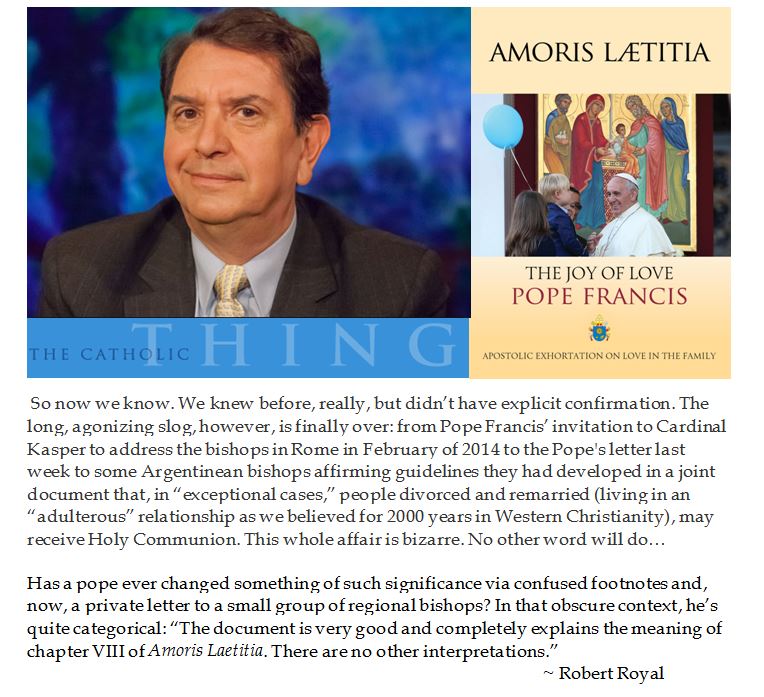
Robert Royal on Pope Francis Bizarre Papal Move on Sacramental Marriage


Robert Royal, the editor of The Catholic Thing, published a scathing critique of Pope Francis' "Bizarre Papal Move" regarding sacramental marriage, particularly the circumstance around the question of receipt of communion by divorced and remarried Catholics.


It is troubling to see how there seems to have been a Kabuki show of holding two Extraordinary Synods on the Family, in which a clear majority of Bishops reaffirmed the traditional teaching, yet that formal process seems to have mooted by unclear footnotes in the Apostolic Exhortation Amoris Laetitia and papal private letters.

In the late 20th Century, the Catholic Church had been blessed by two pontiffs who were extraordinary theologians.  It is not necessary for a successor to the Chair of Peter to be like Pope St. John Paul II and Pope Benedict XVI.

Pope Francis has a gift of outreach and seems to operate on a more pastoral bent.  Pope Francis' encyclical Laudato Si (2015) read like a hot mess. In Laudato Si, Pope Francis tried to extol a humane ecology but lapsed into six paragraphs championing Global Climate change politics as well as exhortations to forgo air conditioning and i-pads. Thus it is easy to interpret Pope Francis' quip about those who do not recycle needing to go to a confessional as a pastoral hyperbole colored by his concern for ecology.

However, it is troubling that Pope Francis' apparent will, infused with Mercy, seems to override two millennia of Church teachings on on the Sacramentality of Marriage  as well as established mechanisms for discerning and promulgating God's will for the Church.

As a practical Catholic, I must on occasion explain that everything which the Pope says is not infallible. While I ought to prayerfully consider things which a Pope says, I am not bound unless it is an ex cathedra statement. Dogma must be consistent with the Magisterium and aligned with the bishops.

From the inaccurate 2014 relatio, the footnote foundation and private letter reiteration of Pope Francis' view on Kasperian gradualism  for what were traditionally held as adulterous couples, this new teaching on marriage seems on shaky ecclesiastical grounds.  Moreover, it lends credence to progressive Catholics, like Democrat Vice Presidential nominee Senator Tim Kaine (D-VA), that the Catholic Church will follow his lead to eventually endorse same-sex marriage.

H/T: The Catholic Thing

Saturday, October 31, 2015

Scary Spiritual Costumes for All Hallow's Eve


The wag wearing the Spirit of Vatican II costume clearly is not a fan of the St. Louis Jesuits repertoire.  But the outfit does bring up a larger question in Catholic culture.  

Many of the changes to the Catholic Church post 1965 were not necessarily mandated by the Second Vatican Council but were enacted under the shaky assumptions of "The Spirit of Vatican II".   This is why during the 2012 "Year of Faith", then Pope Benedict XVI wanted people to contemplate the 50th anniversary of the start of Vatican II through a hermaneutic of continuity rather than a hermaneutic of rupture. 

Those who are not fond of some changes, like guitar masses, communion in the hand, and moving some feast days to Sundays rail through ridicule. 


Ironically, the musician who satirized Vatican II chose to make his point through a repetitious folk music setting which droned on the mundane rather than uplifting motifs. 

Wednesday, June 17, 2015

Laudato Si (Praised Be)... Popey-cock (sic) or a Hot Mess?


The laity have been anxiously awaiting the release of Pope Francis’ first solo encyclical Laudato Si,(2015) which was presumably about Climate Change.  Community Organizers  polled attendees at a DC Green Festival if they were optimistic about the upcoming bull.  Senator James Inhofe (R-OK) was chary about Pope Francis commenting on Climate Change.   Former Senator and 2016 GOP Presidential candidate  Rick Santorum (R-PA) questioned if the Holy See should use the Church's moral authority on Climate Change as there are more pressing issues facing the world.


After  La Repubblica leaked an advance copy of the Vatican document, the mainstream media was quick to report that the New World’s Holy Father unquestionably embraced man-made Climate Change and frowned upon fossil fuels. Some skeptics have quipped that Pope Francis’ pronouncement as Al Gore wearing white robe  and miter.  It also seemed to copy from Hillary Clinton’s speeches that humanity need to change to allow new beliefs, attitudes and lifestyles (para. 202).  Yet such secular caricatures ignores the several anti abortion allusions in the encyclical

Climate Change this was only a small part of Laudato Si, encompassing only several paragraphs of the encyclical, including the unreferenced preamble. The main natural ecological section was paragraphs 165-175 which urged abandoning fossil fuels, imposing renewable energy and the urgent need to establish a true world political authority to stop pollution, manage Sustainable Development and eradicate poverty (para 175).  When reading a rough translation from the Italian of the leaked  187 page, 245 paragraph papal document, this writer took 23 pages of typed notes. The phrase "global warming" (riscaldamento globale) only appeared twice and variations of riscaldamento only appeared 10 times in the entire encyclical.


Pundits have been quick to presume that the faithful must accede to this encyclical.  However, Laudato  Si was not a Thomistic scholastic pronouncement like the Baltimore Catechist but akin to a Vatican II document which is meant to convince and spur dialog. Moreover, if it is not centered on faith and morals, an encyclical is at best an advisory document.


A leitmotif of this encyclical is the linkage between perceived environmental crisis and poverty. Laudato Sii highlights the intimate relationship between the poor and the fragility of planet.  Pope Francis postulates that there should be sustainable development in an ecological manner in tandem with a preferential option for the poor.

Many prior interpretations of the Creation story take it that God put man in charge to dominate the Earth while being fruitful and multiplying. Pope Francis understands the lesson from the Genesis creation story is that humanity was created in God’s image and entrusted to grow and keep the garden of the Earth. This Jesuit Pontiff channeled his inner Franciscan through the title of Laudato Si from the Canticle of St. Francis of Assisi which poetically alludes to  Sister Earth.  To wit, being human recognizes the relation to being created in the image and likeness of God and our relation to the Earth.


Had the encyclical applied this theological take on Creation and correlated it with environmental problems like global warming and pollution it would have been understandable.  However, Pope Francis included brief critiques of technology, labor, bioethics, economics, finance, ecology, GMOs,  anthropology, art, architecture, transportation, infrastructure, culture, trade, polity, animal testing, human trafficking, selling endangered species pelts and man’s raison d’etre as part of an integral examination of the environment.

Laudato Si tried to treat both natural and human social degradation.  In Pope Francis’ estimation:

They are two separate crisis, an environmental and other social, but a single and complex socio-environmental crisis. The guidelines for the solution require an integrated approach to fight poverty, to restore dignity to the excluded and in the same time to take care of nature. 


At times, it was a strain to discern the relation some subjects had to an encyclical supposedly about the environment. Such an collection of short treatments on diffuse issues did not read like a compendium but more like a hot mess of Popey-cock.

It seemed like more an encyclical on Social Justice than it did a treatment on the environment. Ironically, that may be the point. Pope Francis seemed intent on a North-South transfer of wealth as a part of environmental remediation (para. 51).  Furthermore, Pope Francis lamented that we did not use the 2008 Financial Crisis (para 189) as a time to reset the economy to a new ethical principle. Achieving progressive social justice through environmental issues.  The sections which tried to relate the sacraments to nature (para. 235-237 ) along with including the Blessed Virgin Mary and St. Joseph (para. 241-242) to the natural tableau seemed tacked on and tenuous.

Aside from the impulse to especially emphasize the linkage and adverse effect of environmental degradation on the poor, other marks of Pope Francis’ pontificate was collegiality and ecumenism. The Bishop of Rome was careful to cite passages from a half dozen national conferences of Catholic Bishops which were woven into the encyclical.  Moreover, Pope Francis devoted three paragraphs to the Orthodox First Ecumenical Patriarch Bartholomew (para. 7-9) on environmental damage. In addition, Pope Francis offers a paeon to the elemental  beauty in the within Eastern rite mysteries or what we in Western Christianity call sacraments   demonstrating that the Vatican is serious about aligning more with other lung of Apostolic Christendom, the Eastern Orthodox Churches which are not in communion with Rome.

Pope Francis predicated his commentary of the ecology by citing encyclicals of his predecessors over the last 65 years.  The inclusion of Pope St. John XXIII had little to do with the environment but the cri-de-coeur against nuclear arms tangentially showed concern for man made pollution and commenting on contemporary political topics.  Laudato Si quoted Pope St. John Paul II 21 times as well as Pope (now Emeritus) Benedict XVI a similar amount of citations.  It reminds the faithful that Pope Francis was preceded by two theological scholarly giants from whom we will be benefitting for years to come.

Despite invoking the modern tradition, Laudato Si lacked many references to early Church fathers.  Of course, the title of the encyclical came from St.  Francis of Assisi. There were brief quotations from St. Thomas Aquinas (para. 88), St. Benedict (para. 126), and the Little Flower St. Therese of Lisieux (para. 221) et ali but nothing from those who practiced “The Way”or the early Patriarchs of the Church .  Moreover, the New Testament scriptural backbone seemed weak.  The claim that Jesus was in harmony in nature (para. 98) sounded spurious. The fact that Jesus taught using agricultural and  natural parables (para. 97) was an odd justification for environmentalism. Noting that Jesus was the model for might not making right (para. 82 cf Mt 20.25 to 26) only relates to environmentalism in so far as there is a nexus between the meek and environmental degradation.

While the curia certainly helped draw up this draft, the language seemed slanted to reflect Pope Francis’ animus against Capitalism with a prejudice against profit and privatization.  When listing misusing technology causing environmental degradation, leading the list was America's use of atomic bombs, followed by communism's exploits and then fascism (para. 104). Much to the chagrin on many Western Progressives, Pope Francis repeated condemns the culture of consumerism and technology which depletes precious resources.  So Climate Change enthusiasts should be willing to sacrifice their i-Phones (para. 47), their own cars (para. 153) as well as their A/C (para. 55).

Although there are several references to differences in opinion and approach to the environment, Pope Francis’ peroration refers to Christians committed to prayer who make a mockery of environmental concerns with the pretense of being realistic or pragmatic (para. 217),  This embodies progressive intolerance of dissent.  One wonders if mollifying mockery about man made climate change goes both ways, as Vice President Joe Biden just jibed that: “As hard as it is to believe, many of these same people continue to deny the reality of climate change. They also deny gravity."

 This prima facia critique of Laudoto Si will not dwell in details about competing data disputing anthropogenic global warming, but the so called consensus is in dispute and scandal from the East Anglia hockey stick model show how data was manipulated for the profit of further investment in climate change studies.

Despite spending hours reading the rough translation from Italian, it is prudent to withhold final judgment on the piece until the official translation into English is released. Aside from ensuring that the leak genuinely reflected the substance of the encyclical, a better translation might ameliorate some of the rough edges of the purported Vatican document.

Upon an initial reading, some of Laudato Si’s segments seem rather long-winded and obtuse.  For instance, paragraph 106 on technology leading to a homogeneous one dimensional paradigm is 267 words long and initially reads like word salad.  Some passages like the opening of paragraph 228 sound like a bromide in rough translation: “Caring for nature is part of a style of life that involves the ability to live together and communion”. Such a lengthy encyclical may yield later blossoming fruit, particularly if meaning is lost in translation.

This leads to how the faithful ought to eventually consider Laudato Si. A non-Catholic friend inquired if Catholics needed to intellectually march lock step when the Pope says something. Explanations about the rare ex cathedra statements on faith and morals are difficult for non Catholics to grasp, and many believers will blindly follow their faith leader’s pensee.
 
 Pope Francis made clear, however,  that “The Church does not claim to define the issues scientific, nor to replace politics, but invitation an honest and transparent debate”. (para. 188).   So Catholics need not bow down to the beliefs in Laudato Si but prayerfully consider the message and participate in the debate.  The manifold political prescriptions which the pontiff proffered were interesting and from the heart but not within his proper sphere of influence.  It is novel to stress a linkage between the poor and environmental degradation, but some of Pope Francis’ solutions of relying on renewable power will cause energy prices to skyrocket, directly hurting the poor.

While Pope Francis’ asceticism is admirable, his proscription of “Less is more” (para. 222)  is questionable for the masses, especially as a response to an asserted ecological crisis. It also leads to the prickly particular of who decides how much is enough. In Laudato Si, Pope Francis encouraged people to do little things, like use covers instead of turning up the heat, not because it will solve problems but for a conversion of heart (para. 212).  There may be a special place in heaven for such symbolic sacrifice, but it runs counter to policy condemnation of fossil fuels and excoriating buying green credits.

This philippic against pollution, environmental and social, is certainly well intended.  The unfocused nature of the encyclical makes it challenging to catachetize among the faithful, much less the world at large. It would seem that Laudato Si fuses Sustainable Development with Social Justice. By progressively engaging in political subjects outside of the Holy See’s spiritual authority, Pope Francis may have alienated good will among non-progressive faithful. Furthermore, the policy prescriptions in Laudato Si seem founded on third way intellectualism, which has few real world successes and is rife for polemic exploitation. What was proposed as an invitation for honest and transparent dialog on the environment is also presented as a rush to consensus due to exigency, which stifles the discernment of unpopular opinions to “Do something now”.

There have been other Catholic teaching documents which have broached on public policy pronouncements, like the USCCB pastoral letter  “The Challenge of Peace” (1983) on nuclear weapons (around the deployment of the Pershing Missiles in Europe) which was not universally well received among the faithful.

Pope Benedict’s encyclical Caritas in Veritas (2009), which the New York Times characterized as “ a puzzling cross between an anti-globalization tract and a government white paper.”  University of Dayton theologian Vincent J. Miller noted that Caritas in Veritas intentionally juxtaposed “paragraphs that sound like Ayn Rand, next to paragraphs that sound like ‘The Grapes of Wrath”.  Pope Emeritus Benedict XVI’s call for one world government based on European Social Democracy did not have the resonance to stay in the public mind for long, yet Pope Francis cited it for the urgent New World Order. Considering that much of Laudato Si sounds like the Holy Father is singing from the Progressives’ hymnal, this encyclical may be used to enviro-shame opponents of radical green solutions, as the left conveniently forgets about the condemnation of consumerist culture and not valuing unborn life.

It is regrettable that Laudato Si was not more tersely cogent to challenge the faithful on natural problems.  It was awkward to have a religious document from a spiritual leader proscribe public policy solutions (get rid of fossil fuels and opt for renewable energy) with a pastiche of spiritual anchors.

Sunday, April 12, 2015

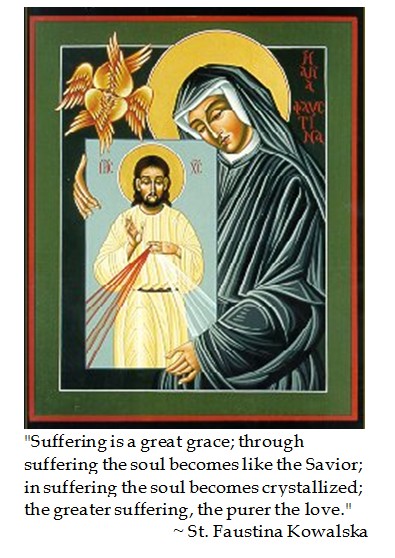
St. Faustina Kowalska on Suffering

St. Faustina Kowalska on Suffering

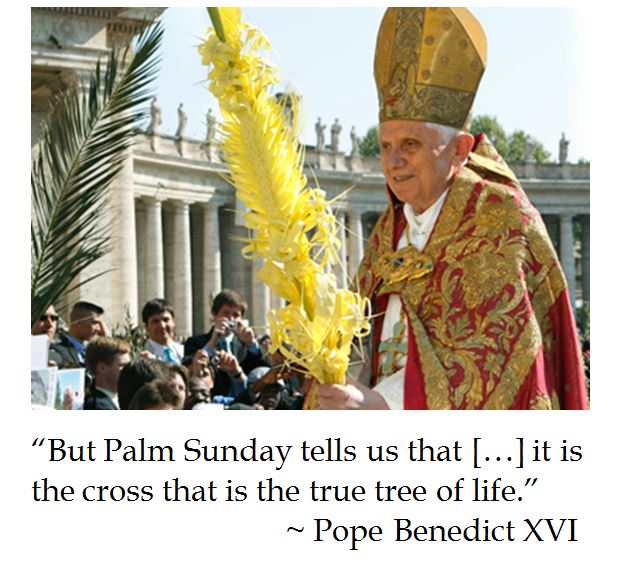
 The day that he was elected to fill the Chair of St. Peter, Pope Benedict XVI spoke about Pope St. John Paul II's devotion to the Divine Mercy:

 "We listen with joy to the proclamation of the year of mercy... Jesus Christ is divine mercy in person. To find Christ means to find the mercy of God...The day of vengeance and the year of favor coincide in the paschal mystery, in Christ, dead and risen.  This is the vengeance of God: He himself, in the person of the Son, suffered for us.  The more we are touched by the mercy of the Lord, the more we are in solidarity with his suffering, the more disposed we are to complete in our flesh 'what is lacking in Christ's afflictions'." 

This message of divine mercy was echoed throughout Pope Benedict's papacy.

Sunday, November 16, 2014

Ecumenism Has Gone Awry at DC's National Cathedral


Despite Reverend Franklin Graham's disappointment which he shared on Twitter about the Muslim led prayer service at Washington National Cathedral, this is not the first time that the sixth largest Cathedral church in the world  has ecumenically opened its doors to non-Christian worship.


In January 2014, the Washington National Cathedral hosted "Seeing Deeper" which welcomed worshipers of different faith to bring  prayer mats, yoga mats, zafu meditation cushions and mandalas to touch the divine.  So having a Muslim led prayer service is not surprising.  

Regarding the recent Muslim Prayer Service, the Dean of National Cathedral Gary Hall was unaware or did not care that the Muslim prayer service at Washington National Cathedral was held on the centennial of the last Caliph declaring a holy war on all non-believers. When Breitbart News journalists informed the rector, Rev. Hall equivocated:  "[I]t actually seems to be more appropriate to have an event that is on an anniversary of a hard time… There have been atrocities on both sides. There have been extremists on both sides.”  After pointing out that Menachem Begin and many founders of the state of Israel were "terrorists",  the Episcopal minister mused: “Everyone’s hands are dirty at some point… There’s no one in the world who has absolutely clean hands."

Muslim led Friday Prayers at Washington National Cathedral Nov. 14, 2014 [photo source: AFP]


The prayer carpets for the around two hundred Muslim faithful gathered for the Jumu'ah (Muslim Prayer Service) were laid diagonally in the transept on the side of the sanctuary to face Mecca without seeing any Christian icons, as Islam forbids prayer in view of sacred symbols which are alien to their faith. 

Before the prayers started, a lone protester proclaimed: "Jesus died on that Cross for us.  Jesus Christ is our Lord and Savior." before being whisked out of the supposedly Christian church.


It seems that forthrightly proclaiming the faith in the House of God which a Cathedral church represents is unwelcomed at Washington National Cathedral.  It runs counter to what Rev. Canon Gina Campbell, the Cathedral's liturgical director, espoused in publicizing the event:  “This needs to be a world in which all are free to believe and practice and in which we avoid bigotry, Islamaphobia, racism, anti-Semitism, and anti-Christianity and to embrace our humanity and to embrace faith.”

The Right Reverend Gary Hall has interesting ideas about ecumenism.  Hall does not believe in talking about God with members of different faith as that only leads to arguments.  Instead Hall believes that "Let's all pray together and experience the divine together in our own way."  It ignores the great commission of MT: 28:16-20 but why be pushy about divine matters for the National House of Prayer?   

Washington National Cathedral was founded on a charter from Congress but it is an Episcopal Cathedral.  While it is wonderful to reach out to people of faith to find commonalities, it seems pusillanimous to not represent the faith at the seat of the Archbishop, who should be shepherding the flock.  Moreover, treating Washington National Cathedral like an International House of Prayer seems like it is making it a big venue religious entertainment.  Then again the Very Reverend Gary Hall wished about to roller skate or throw paper airplanes down the temporarily empty nave of Washington National Cathedral

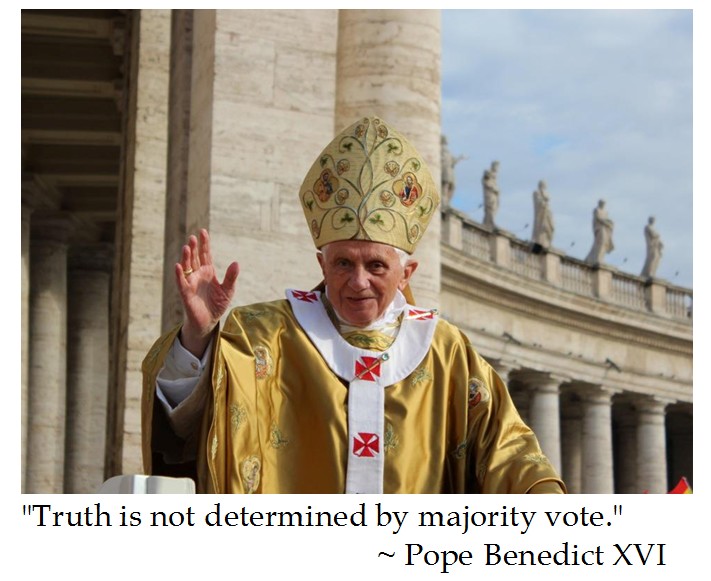
Ecumenism is illuminating and foster tolerance and perhaps peace in the proper context. This is often accomplished through interfaith prayer services, which may concentrate on the spiritual things which unite various confessions.  However, a renunciation of truth by not sharing the Good News when worshiping in a Cathedral church is indeed troubling. This leads to what Pope (Emeritus) Benedict XVI labeled a renunciation of truth that is lethal to faith.  When eternal symbols become inter-changible, we may find ourselves singing: "Have a RamahanuKwanzMas" soon. 

Pope (Emeritus) Benedict XVI on Ecumenism

Pope Benedict XVI on Ecumenism

Friday, November 7, 2014

Costing Out Annulment Analogies


One of the hot button issues during the Extraordinary Synod on the Family in 2014 was how the Catholic Church dealt with the sad cases of civilly divorced Catholics who wish to remarry and receive the sacraments.  Cardinal Walter Kasper, a theologian whom Pope Francis complimented early in his papacy, has long sought to remedy the stark consequences of this broken marital situation.

 In the midterm relatio, paragraphs 53 and 55 sought to "study" the situation of divorced and remarried persons or those living together as well as to find a pastoral provision with a penitential process (established by a bishop) for receiving the sacrament.  Such interventions in the relatio were not well received.  Thus they were opposed by the likes of Cardinal George Pell, pointing to scripture, such as in Matthew 5:32, which makes dissolution of the marital covenant difficult, except in limited circumstances.

As the Synod Fathers voted on the final report for the 2014 Synod, conciliatory language dealing with the treatment of divorced and remarried Catholics narrowly failed to pass.  But in the run up to the month-long Synod on the Family in October, 2015, the faithful are  ruminating over the issues which challenge family life.

Pope Francis gave an audience in the Vatican in which he bemoaned the high costs and long adjudication of some marriage tribunals.


Pope Francis recalled an unspecified instance when he was the Archbishop of Buenos Aires in which a member of the marriage tribunal had to be expelled because the corrupt church official offered to take at $10,000 bribe to make sure that everything ran smoothly.  Although that anecdote may be authentic, is sounds suspiciously similar to sales pitches to pass Obamacare so that doctors do not make more money for unnecessary surgeries.

In North America, cost is not the issue in discouraging annulments.  Per the Archdiocese of Baltimore, costs for annulments to petitioners run between $100 to $500 (and that is only half of the actual costs).  If Rome Reports is accurate, the adjudicator may be entitled to $1,000.  However, the Baltimore Archdiocese stresses that no one is turned away for their inability to pay.  Here it does not seem like cost is a factor.

There may be some frustration with the faithful about the time to adjudicate. There is the persistent perception that it takes three to five years to gain a declaration of nullity (annulment), when it can depending upon the case take as little as eight months.

 A friend who was civilly divorced against his volition has chosen not to get an annulment because of not dating and being to busy being a parent.  When we spoke of the hot button issues at the Synod of the Family, he wondered why it takes so long for the Church to reach an answer on the validity of marriage.  This echoes the Holy Father.  However, his construct for regaining access to the sacrament was concerning.

He perceives Penance as being a case where a penitent acts as the defendant and prosecutor looking for adjudication from the priest acting in the stead of the Divine Judge.  Therefore, a simplified penitential process for divorced and remarried Catholics could be something similar to "Je me accuse". One confesses one's sins and then is given absolution.

For me, calling the Sacrament of Reconciliation "Penance" is the wrong way to look at that sacrament. Scripture tries to explain the Divine with different metaphors.  If a person gets stuck on the Judge and Trial schema, it is easy to think of the Lord sitting on His throne being a Divine Scorekeeper and we pay for our sins.  A better way to understand Reconciliation may be through the lens of the "Prodigal Father", who runs to greet his prodigal son who approaches with humility and seeks to restore relationship.

That being said, if one uses a penitential perspective towards remarried Catholics, of what are they accusing themselves.  The dissolution of the marriage is not the reason for excommunication, the subsequent conjugal marriage is.  So what would they be confessing?  Thinking of a spouse who was divorced against his or her will, how did they do wrong?   As for the latter intimate relationship, how can a penitent vow to sin no more if the prior marriage was sacramental in nature?

Canon law is concerned about five elements of a sacramental marriage:


  • The spouses were free to marry; 
  • they freely exchanged their consent; 
  •  they intended to marry for life, be faithful and be open to children; 
  •  they intended “good of each other"
  •  and their consent was given in the presence of witnesses before an authorized church official.
The current process may take time to discern intentions.  If the process is streamlined and rushed, will this devalue the scriptural exhortation on the covenant of marriage which is presumed to be indissoluble?

As Catholics discern the challenges of the family in modern life, we ought not to discount essential doctrine on the sacramental nature of marriage to satisfy secular trends. 

For close to a century, Anglicans have been wrestling with the wrath of modernism.  Many see 1930 the Council of Lambeth opening up a door to dissent and doctrinal indifference.  During the Council of Lambeth, Resolution 15 passed, which was a narrow exception to allow contraception for married couples.  That seems to have established a precedent for accommodating the ways of the world, despite what scripture, tradition and Anglican's understanding of a Magisterium.  So much so, Anglo-Catholics have been willing to swim the Tiber to keep the faith, encouraged by Pope Benedict XVI's moto propio Anglicanorum Coetibus, which established a Personal Ordinariate for Anglicans within the Catholic Church.

May our impetus to better convey the new Evangelization continue to preach the Good News of the Gospel.

h/t: RomeReports

Wednesday, October 29, 2014

Pope Francis on Pope (Emeritus) Benedict XVI


During a plenary session of the Pontifical Academy of Sciences, Pope Francis lauded his predecessor in association with the dedication of a bust of Pope (Emeritus) Benedict XVI.  Pope Francis noted that Pope Benedict' "love of truth is not limited to theology and philosophy, but is open to science."  In addition, Pope Francis' observed that the bust recalled Pope Benedict's "spirit of his teachings, his example , his works, his devotion to the Church."

The bronze of Benedict XVI  was commissioned by the Pontifical Academy of Sciences to sculptor Fernando Delia, a lawyer who is a self taught artist   was sculpted by Fernando Delia will be placed in the at the headquarters of the Pontifical Academy of Sciences. Pope Francis credits Delia with projecting Pope Benedict XVI's  " joyful emotion " for "recognition and gratitude " 


h/t: Romereports.com