

Showing posts with label JPII. Show all posts
Showing posts with label JPII. Show all posts
Sunday, June 4, 2017

Saturday, May 13, 2017
Thursday, May 26, 2016
Thursday, October 22, 2015

Wednesday, June 17, 2015
Laudato Si (Praised Be)... Popey-cock (sic) or a Hot Mess?

The laity have been anxiously awaiting the release of Pope Francis’ first solo encyclical Laudato Si,(2015) which was presumably about Climate Change. Community Organizers polled attendees at a DC Green Festival if they were optimistic about the upcoming bull. Senator James Inhofe (R-OK) was chary about Pope Francis commenting on Climate Change. Former Senator and 2016 GOP Presidential candidate Rick Santorum (R-PA) questioned if the Holy See should use the Church's moral authority on Climate Change as there are more pressing issues facing the world.

 After La Repubblica leaked an advance copy of the Vatican document, the mainstream media was quick to report that the New World’s Holy Father unquestionably embraced man-made Climate Change and frowned upon fossil fuels. Some skeptics have quipped that Pope Francis’ pronouncement as Al Gore wearing white robe and miter. It also seemed to copy from Hillary Clinton’s speeches that humanity need to change to allow new beliefs, attitudes and lifestyles (para. 202). Yet such secular caricatures ignores the several anti abortion allusions in the encyclical
Climate Change this was only a small part of Laudato Si, encompassing only several paragraphs of the encyclical, including the unreferenced preamble. The main natural ecological section was paragraphs 165-175 which urged abandoning fossil fuels, imposing renewable energy and the urgent need to establish a true world political authority to stop pollution, manage Sustainable Development and eradicate poverty (para 175). When reading a rough translation from the Italian of the leaked 187 page, 245 paragraph papal document, this writer took 23 pages of typed notes. The phrase "global warming" (riscaldamento globale) only appeared twice and variations of riscaldamento only appeared 10 times in the entire encyclical.

 Pundits have been quick to presume that the faithful must accede to this encyclical. However, Laudato Si was not a Thomistic scholastic pronouncement like the Baltimore Catechist but akin to a Vatican II document which is meant to convince and spur dialog. Moreover, if it is not centered on faith and morals, an encyclical is at best an advisory document.
A leitmotif of this encyclical is the linkage between perceived environmental crisis and poverty. Laudato Sii highlights the intimate relationship between the poor and the fragility of planet. Pope Francis postulates that there should be sustainable development in an ecological manner in tandem with a preferential option for the poor.
Many prior interpretations of the Creation story take it that God put man in charge to dominate the Earth while being fruitful and multiplying. Pope Francis understands the lesson from the Genesis creation story is that humanity was created in God’s image and entrusted to grow and keep the garden of the Earth. This Jesuit Pontiff channeled his inner Franciscan through the title of Laudato Si from the Canticle of St. Francis of Assisi which poetically alludes to Sister Earth. To wit, being human recognizes the relation to being created in the image and likeness of God and our relation to the Earth.

Had the encyclical applied this theological take on Creation and correlated it with environmental problems like global warming and pollution it would have been understandable. However, Pope Francis included brief critiques of technology, labor, bioethics, economics, finance, ecology, GMOs, anthropology, art, architecture, transportation, infrastructure, culture, trade, polity, animal testing, human trafficking, selling endangered species pelts and man’s raison d’etre as part of an integral examination of the environment.
Laudato Si tried to treat both natural and human social degradation. In Pope Francis’ estimation:
They are two separate crisis, an environmental and other social, but a single and complex socio-environmental crisis. The guidelines for the solution require an integrated approach to fight poverty, to restore dignity to the excluded and in the same time to take care of nature.
At times, it was a strain to discern the relation some subjects had to an encyclical supposedly about the environment. Such an collection of short treatments on diffuse issues did not read like a compendium but more like a hot mess of Popey-cock.
It seemed like more an encyclical on Social Justice than it did a treatment on the environment. Ironically, that may be the point. Pope Francis seemed intent on a North-South transfer of wealth as a part of environmental remediation (para. 51). Furthermore, Pope Francis lamented that we did not use the 2008 Financial Crisis (para 189) as a time to reset the economy to a new ethical principle. Achieving progressive social justice through environmental issues. The sections which tried to relate the sacraments to nature (para. 235-237 ) along with including the Blessed Virgin Mary and St. Joseph (para. 241-242) to the natural tableau seemed tacked on and tenuous.
Aside from the impulse to especially emphasize the linkage and adverse effect of environmental degradation on the poor, other marks of Pope Francis’ pontificate was collegiality and ecumenism. The Bishop of Rome was careful to cite passages from a half dozen national conferences of Catholic Bishops which were woven into the encyclical. Moreover, Pope Francis devoted three paragraphs to the Orthodox First Ecumenical Patriarch Bartholomew (para. 7-9) on environmental damage. In addition, Pope Francis offers a paeon to the elemental beauty in the within Eastern rite mysteries or what we in Western Christianity call sacraments demonstrating that the Vatican is serious about aligning more with other lung of Apostolic Christendom, the Eastern Orthodox Churches which are not in communion with Rome.
Pope Francis predicated his commentary of the ecology by citing encyclicals of his predecessors over the last 65 years. The inclusion of Pope St. John XXIII had little to do with the environment but the cri-de-coeur against nuclear arms tangentially showed concern for man made pollution and commenting on contemporary political topics. Laudato Si quoted Pope St. John Paul II 21 times as well as Pope (now Emeritus) Benedict XVI a similar amount of citations. It reminds the faithful that Pope Francis was preceded by two theological scholarly giants from whom we will be benefitting for years to come.
Despite invoking the modern tradition, Laudato Si lacked many references to early Church fathers. Of course, the title of the encyclical came from St. Francis of Assisi. There were brief quotations from St. Thomas Aquinas (para. 88), St. Benedict (para. 126), and the Little Flower St. Therese of Lisieux (para. 221) et ali but nothing from those who practiced “The Way”or the early Patriarchs of the Church . Moreover, the New Testament scriptural backbone seemed weak. The claim that Jesus was in harmony in nature (para. 98) sounded spurious. The fact that Jesus taught using agricultural and natural parables (para. 97) was an odd justification for environmentalism. Noting that Jesus was the model for might not making right (para. 82 cf Mt 20.25 to 26) only relates to environmentalism in so far as there is a nexus between the meek and environmental degradation.
While the curia certainly helped draw up this draft, the language seemed slanted to reflect Pope Francis’ animus against Capitalism with a prejudice against profit and privatization. When listing misusing technology causing environmental degradation, leading the list was America's use of atomic bombs, followed by communism's exploits and then fascism (para. 104). Much to the chagrin on many Western Progressives, Pope Francis repeated condemns the culture of consumerism and technology which depletes precious resources. So Climate Change enthusiasts should be willing to sacrifice their i-Phones (para. 47), their own cars (para. 153) as well as their A/C (para. 55).
Although there are several references to differences in opinion and approach to the environment, Pope Francis’ peroration refers to Christians committed to prayer who make a mockery of environmental concerns with the pretense of being realistic or pragmatic (para. 217), This embodies progressive intolerance of dissent. One wonders if mollifying mockery about man made climate change goes both ways, as Vice President Joe Biden just jibed that: “As hard as it is to believe, many of these same people continue to deny the reality of climate change. They also deny gravity."
This prima facia critique of Laudoto Si will not dwell in details about competing data disputing anthropogenic global warming, but the so called consensus is in dispute and scandal from the East Anglia hockey stick model show how data was manipulated for the profit of further investment in climate change studies.
Despite spending hours reading the rough translation from Italian, it is prudent to withhold final judgment on the piece until the official translation into English is released. Aside from ensuring that the leak genuinely reflected the substance of the encyclical, a better translation might ameliorate some of the rough edges of the purported Vatican document.
Upon an initial reading, some of Laudato Si’s segments seem rather long-winded and obtuse. For instance, paragraph 106 on technology leading to a homogeneous one dimensional paradigm is 267 words long and initially reads like word salad. Some passages like the opening of paragraph 228 sound like a bromide in rough translation: “Caring for nature is part of a style of life that involves the ability to live together and communion”. Such a lengthy encyclical may yield later blossoming fruit, particularly if meaning is lost in translation.
This leads to how the faithful ought to eventually consider Laudato Si. A non-Catholic friend inquired if Catholics needed to intellectually march lock step when the Pope says something. Explanations about the rare ex cathedra statements on faith and morals are difficult for non Catholics to grasp, and many believers will blindly follow their faith leader’s pensee.
Pope Francis made clear, however, that “The Church does not claim to define the issues scientific, nor to replace politics, but invitation an honest and transparent debate”. (para. 188). So Catholics need not bow down to the beliefs in Laudato Si but prayerfully consider the message and participate in the debate. The manifold political prescriptions which the pontiff proffered were interesting and from the heart but not within his proper sphere of influence. It is novel to stress a linkage between the poor and environmental degradation, but some of Pope Francis’ solutions of relying on renewable power will cause energy prices to skyrocket, directly hurting the poor.
While Pope Francis’ asceticism is admirable, his proscription of “Less is more” (para. 222) is questionable for the masses, especially as a response to an asserted ecological crisis. It also leads to the prickly particular of who decides how much is enough. In Laudato Si, Pope Francis encouraged people to do little things, like use covers instead of turning up the heat, not because it will solve problems but for a conversion of heart (para. 212). There may be a special place in heaven for such symbolic sacrifice, but it runs counter to policy condemnation of fossil fuels and excoriating buying green credits.
This philippic against pollution, environmental and social, is certainly well intended. The unfocused nature of the encyclical makes it challenging to catachetize among the faithful, much less the world at large. It would seem that Laudato Si fuses Sustainable Development with Social Justice. By progressively engaging in political subjects outside of the Holy See’s spiritual authority, Pope Francis may have alienated good will among non-progressive faithful. Furthermore, the policy prescriptions in Laudato Si seem founded on third way intellectualism, which has few real world successes and is rife for polemic exploitation. What was proposed as an invitation for honest and transparent dialog on the environment is also presented as a rush to consensus due to exigency, which stifles the discernment of unpopular opinions to “Do something now”.
There have been other Catholic teaching documents which have broached on public policy pronouncements, like the USCCB pastoral letter “The Challenge of Peace” (1983) on nuclear weapons (around the deployment of the Pershing Missiles in Europe) which was not universally well received among the faithful.
Pope Benedict’s encyclical Caritas in Veritas (2009), which the New York Times characterized as “ a puzzling cross between an anti-globalization tract and a government white paper.” University of Dayton theologian Vincent J. Miller noted that Caritas in Veritas intentionally juxtaposed “paragraphs that sound like Ayn Rand, next to paragraphs that sound like ‘The Grapes of Wrath”. Pope Emeritus Benedict XVI’s call for one world government based on European Social Democracy did not have the resonance to stay in the public mind for long, yet Pope Francis cited it for the urgent New World Order. Considering that much of Laudato Si sounds like the Holy Father is singing from the Progressives’ hymnal, this encyclical may be used to enviro-shame opponents of radical green solutions, as the left conveniently forgets about the condemnation of consumerist culture and not valuing unborn life.
It is regrettable that Laudato Si was not more tersely cogent to challenge the faithful on natural problems. It was awkward to have a religious document from a spiritual leader proscribe public policy solutions (get rid of fossil fuels and opt for renewable energy) with a pastiche of spiritual anchors.
Sunday, April 12, 2015
St. Faustina Kowalska on Suffering
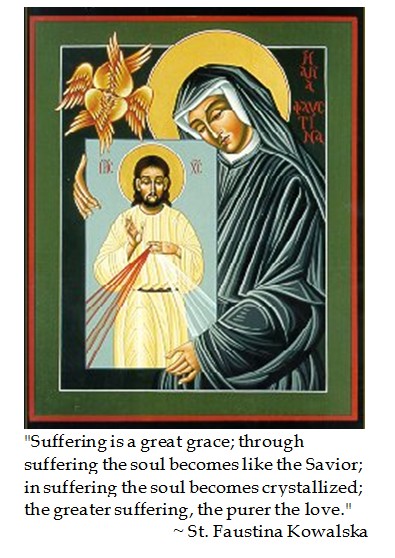
The day that he was elected to fill the Chair of St. Peter, Pope Benedict XVI spoke about Pope St. John Paul II's devotion to the Divine Mercy:
"We listen with joy to the proclamation of the year of mercy... Jesus Christ is divine mercy in person. To find Christ means to find the mercy of God...The day of vengeance and the year of favor coincide in the paschal mystery, in Christ, dead and risen. This is the vengeance of God: He himself, in the person of the Son, suffered for us. The more we are touched by the mercy of the Lord, the more we are in solidarity with his suffering, the more disposed we are to complete in our flesh 'what is lacking in Christ's afflictions'."
This message of divine mercy was echoed throughout Pope Benedict's papacy.
Monday, November 17, 2014
Cardinal Sean O'Malley on Ordinations

During an interview with CBS News, Archbishop of Boston Sean Cardinal O'Malley offered an interesting opinion on ordinations.
Much of the interview centered around Cardinal O'Malley's work in reforming clerical child abuse. But when the interviewer Nora O'Donnell pressed Cardinal Sean on whether it was immoral for the Catholic hierarchy to exclude women, O'Malley opined: “Christ would never ask us to do something immoral. It’s a matter of vocation and what God has given to us.”
Overall, the focus of the piece was to paint the bad old Catholic hierarchy as "The Holy See of Misogyny", which subjugates women to second class status, abuses children because of the discipline of clerical celibacy and denies womens' "right to choose" (from contraception to abortion).
In a short interview meant for a general audience, Cardinal Sean did not have the ability to put into soundbites all of the elements of Pope St. John Paul II's Ordinatio Sacerdotales (1994), which declares that there is no scriptural support for priestesses as well as underlining the Magisterium about the Church's teaching authority.
Perhaps Cardinal Sean's vellity about "if I were starting a church" is part of a New Evangelization outreach, but this did not seem like a positive reintroduction of doctrine to the unchurched.
Wednesday, October 22, 2014

Sunday, April 27, 2014

Sunday, September 1, 2013
Thursday, April 11, 2013
Holy Non-Sequiturs!

While Burt Ward would not confuse the Holy of the Holies, the Boy Wonder certainly packed some verbal punch around his super-hero cohort.
Wednesday, February 13, 2013
Prayer at the Commencement of Our Lenten Journey

Jesus, beloved friend,
you call us to a season of growth and repentance.
You have high hopes for us;
may we not disappoint you.
May we see your face ahead of us,
beaming at the end of our Lenten journey.
Give us the strength and energy to run
towards you during this season.
Give us the integrity and generosity in each new challenge.
We ask this of you who lives and reigns
with God the Father
in the unity of the Holy Spirit,
one God for ever and ever.
Amen.
~ Anonymous
Monday, February 11, 2013
Pope Benedict XVI Resigns
 |
| Benedict XVI upon his election April 19, 2005 [AP photo: Domenico Stinellis] |
It was a shock to the world the Pope Benedict XVI (ne Josef Ratzinger) offered a letter of resignation today from the Papacy during a consistory which was just slated to canonize three saints. Benedict XVI was elected pope April 19, 2005 and at age 78 was the oldest Pope elected to the Chair of St. Peter. Cardinal Ratizinger had developed a reputation as a doctrinaire Rottweiler as he headed the Sacred Congregation for the Doctrine of the Faith (the office of Holy Inquisition) during most of Pope Blessed John Paul II’s 26 ½ year reign . Benedict XVI surprised critics as being a gentle German Shepherd during his nearly eight year tenure leading the Catholic Church.
Pope Benedict XVI’s resignation will take effect as of February 28, 2013 8 pm Rome time. There will be a two week period when it will sede vacante and then the College of Cardinals will meet to vote on who will become the next Pope.
 |
| Pope Benedict XVI Crest |
In his letter of resignation, Pope Benedict XVI noted:
After having repeatedly examined my conscience before God, I have come to the certainty that my strengths, due to an advanced age, are no longer suited to an adequate exercise of the Petrine ministry. I am well aware that this ministry, due to its essential spiritual nature, must be carried out not only with words and deeds, but no less with prayer and suffering. However, in today’s world, subject to so many rapid changes and shaken by questions of deep relevance for the life of faith, in order to govern the bark of Saint Peter and proclaim the Gospel, both strength of mind and body are necessary, strength which in the last few months, has deteriorated in me to the extent that I have had to recognize my incapacity to adequately fulfill the ministry entrusted to me.
...
Generally, the Papacy is considered a calling to one's Earthly end. Pope Blessed John Paul II's difficult health decline from Parkinson's Disease and the effects of his 1981 assassination attempt was a object lesson on the dignity of human life and natural death, the redemptive value of suffering and some might argue martyrdom. One can draw lessons from Pope Benedict XVI's "intentional grounding" as a selfless act which demonstrates humility and the desire to best serve the Lord in building the Kingdom of God.
READ MORE at DCBarroco.com
Thursday, January 31, 2013
John Paul II's Prayer of Trust

A prayer of Pope Blessed John Paul II.
Subscribe to:
Posts (Atom)