Preface:
This piece was originally written in October 2016 after participating in an Igantian retreat aimed at rolling out this Apostolic Encyclical to the faithful. The resulting article seemed too lengthy for publication and impossible to edit down to a "typical Readers Digest" version. However, I have passionately argued specifics from the analysis when discussing Amoris Laetitia and some have expressed interest in reading the piece.
Perhaps the capstone of Pope Francis’ Jubilee Year of Mercy is the promulgation of the
Apostolic Exhortation-- Amoris Laetitia (The Joy of Love, 2016).
Amoris Laetitia is Pope Francis’ reflections on the 2014 and 2015 Extraordinary Synods of the Family.
Pope Francis’ persistently reaches out to minister to those in the peripheries, especially those in irregular family situations. However
Amoris Laetitia has created sparks from critics who wonder about how the document ought to be interpreted and ramifications from its proposed New Mercy implementation.
While
Amoris Laetitia purports to reflect the Extraordinary Synods on the Family’s final report, it goes beyond chronicling the Synod Fathers conclusions. As is Pope Francis’ style, the Holy Father wrote a long work (356 paragraph 264 page English document) piece that mixes in pastoral suggestions along poetic, collegial (citing various Conferences of Bishops) and scriptural allusions as well as quoting the preceding pontiffs’ teachings.
Pope Francis’ charismatic communication style is not always exact in nature and his spontaneous utterances can seem contradictory.
Much of the material in
Amoris Laetitia mirrored the Magisterium and the final report of the Synod of the Family Fathers.
- Marriage is a gift from the Lord between a man and a woman for life (para. 62) .
- Same Sex unions can not be equated with marriage (para. 52).
- Gender theory which denies sexual differences between men and women is rejected (para. 56)
- Blessed Pope Paul VI’s teaching from the encyclical Humanae Vitae (1968) which prohibited artificial contraception is reaffirmed (para. 68).
- Abortion is explicitly condemned and the right of health care workers conscience to respect the sanctity of life in their profession is stressed. (para. 83).
- The education of children is the “primary right” of parents (para. 84).
Despite this ample echoing of the Church teaching and tradition, there is some ambiguity on how the faithful ought to interpret
Amoris Laetitia. Unlike other Apostolic Exhortations, Pope Francis proffered pastoral perspectives which are certainly sagacious but are obviously not
ex cathedra, such as suggesting couples take quality time to listen to each other (para 137). Such rhetoric seems reminiscent of documents from Vatican II which sought to persuade rather than inculcate.

The Second Vatican Council (1962-1965) generated an alluvia of documents which exhorted
“aggiornamento” (opening the windows of the Church to the world). The gist of Vatican II documents intimated change couched in consensus committee style. The volume of Vatican documents generated along with sometimes disjointed conclusions inspired some who implemented reforms to invoke
“the Spirit of Vatican II” to actuate changes which the Vatican II Synod Fathers did not advocate
(e.g. changing the altar from ad orientam to versus populem).
The considerable length of
Amoris Laetitia, along with a couple of ambiguous paragraphs make it more more than conceivable that a similar phenomenon of “the Spirit of
Amoris Laetitia” could overshadow the many positive points of this Apostolic Exhortation. Those steeped in Jesuit education may recognize Ignatian elements from the Spiritual Exercises such as accompaniment, discernment and integrating weakness, but they seem insufficiently contexualized and may be unfamiliar to the Church Universal.
The uncertainty on how to understand
Amoris Laetitia is amplified by a predicate for Pope Francis’ reflections:
Since ‘time is greater than space’, I would to make it clear that not all of the discussions of doctrinal, moral or pastoral issues need to be settled by interventions of the Magisterium. Unity of teaching or practice is certainly necessary in the Church, but this does not preclude various ways of interpreting some aspects of that teaching or drawing certain consequences from it. (para. 3).
That seems to suggest that there may be back door mechanisms which circumvent customary Church procedures while also affirming the need for a unity of Church practice. Hence, it crucial to discern the hermaneutic for assessing
Amoris Laetitia.
Employing Pope (Emeritus) Benedict XVI’s dialectic for Vatican II Golden Anniversary observances, should
Amoris Laetitia understand through a be a hermaneutic of continuity or a hermaneutic of rupture? Put another way, does the New Mercy restate and contemporize traditional teachings or does
Amoris Laetitia manifest a new way to address irregular family challenges?
As befitting the Jubilee Year of Mercy, Pope Francis reaches out to the peripheries to reach faithful who might feel estranged from Mother Church. While that is laudable to bring souls back into the fold of the Church, it seems extraordinary for Pope Francis to assert:
It is important divorced who entered into a new union should be made to feel part of the Church. “They are not excommunicated” and they should not be treated as such, since they remain part of the ecclesial community.(para. 243).
This intimates an innovation, as the Magisterium holds that a sacramental marriage is indissoluble hence a civil remarriage without obtaining an annulment (technically a certificate of nullity), then those in the irregular marriage are committing adultery.
Many people mistake Excommunication (barring reception of the sacraments) as a punishment. Some think that it is kicking someone out of the Church. So Pope Francis is quite right to note that they remain part of the Church. But traditionally they would be prohibited from unworthily receiving sacraments, especially the Body and Blood of Christ in a state of grave sin as it imperils their souls.
Pope Francis, however, considers the simple application of Canon Law is characteried as bureaucratic. Pastors are extolled not to throw moral stones and be done with irregular situations. In fact, a footnote states: “I want to remind priest that the confessional must not be a torture chamber, but rather an encounter with the Lord’s mercy (para 305 footnote 351).
Keeping to his Ignation roots, Pope Francis encourages pastors ministering to such irregular marriages to accompany the couple and consider mitigating factors (para. 301). Supposedly, in certain situations, an irregularly married couple may grow in grace while receiving the Church’s help, which may include the sacraments. This is a law of gradualism, which Pope Francis oddly attributes to Pope St. John Paul II’s Apostolic Exhortation
Familiaris Consortio (1981), but more closely tracks with Cardinal Walter Kasper’s theological take on gradualism.
This is the crux of the sparks regarding Amoris Laetitia. This footnote seems like a pastoral end around of Church law, done for the sake of mercy, to a couple which has not resolved impediments. This goes beyond pastoral provisions and calls into question adherence to the traditional teachings of the Church and the meaning of the sacraments.
Chapter Eight of
Amoris Laetitia postulates that there may be some situations which divorced and civilly remarried Catholics can still access the sacraments despite not having an annulment. During the 2015 Synod on the Family,
Prefect for the Congregation of the Doctrine of the Faith Gerhard Mueller stated: "The valid and sacramental marriage is either indissoluble or dissoluble. There is no third option." of So if an irregular couple can still receive sacraments, in the name of mercy, then what is the validity of the rule?
One of the hard teachings in the Gospel of Matthew is the reinstatement of natural marriage.
Jesus replied, "Moses allowed you to divorce your wives because your hearts are unyielding. It it wasn't that way from the beginning. I say to you that whoever divorces his wife, except for sexual unfaithfulness, and marries another woman commits adultery." (M 9: 8-9)
That states things pretty clearly from a scriptural standpoint.
Amoris Laetitia points to other examples in which Jesus has mercy on people in irregular situations, like the woman who was about to be stoned for adultery or the woman at the well.
But certain statements by Pope Francis and the theology concealed in pastoral provisions have cast doubts on the Catholic concept of sacramental marriage, as well as the precepts for other sacraments. In
June 2016, Pope Francis posited that:
the great majority of our sacramental marriages are null" because they do not have a proper understanding of permanence and commitment (official transcripts modified this quip to "a portion").
The gradualist approach, as articulated by Cardinal Kasper, moots the Messiah's invocation of natural law of marriage. It can be liked to how Orthodox Christianity handles divorce and remarriage for
economia (the Orthodox Church’s concern for the salvation of people) giving an irregular couple a tentative blessing after a period of penance. Since
Amoris Laetitia sought to avoid doctrinal interventions of the Magisterium, this comparative theological perspective on second marriages was not spelled out.
Kasperian gradualism looks to
expand the playground between dogmatic principle and pastoral consequence which he attributes to Pope St. John Paul II's concession in Familaris Consortio Kasper exaults the good which can spring forth from the second (non-sacramental) civil marriage of love, commitment and exclusivity. This assertion is troubling since there is still a valid sacramental marriage hence ecclesially there is neither commitment nor exclusivity to the sacramental spouse.
Pope Francis gives latitude to pastoral counseling and may recommend that the counseled couple resume church life in another parish so as not to create scandal. For Cardinal Kasper, the scandal is not irregular Catholic couples unworthily receiving the sacraments but denying the sacraments
In this pastoral process, the couple is to be helped in discernment which “guides the faithful to an awareness of their situation before God” (para. 300). Essentially, this is an appeal to Thomistic sense of conscience, which if sincerely held may countermand established customary procedures. This pastoral process is supposed to be limited to certain situations which:
[I]n an objective situation of sin–which may not be subjectively culpable, or fully such– a person can be living in God’s grace and charity, while receiving the Church’s help to this end. (para 300)
That passage seemed rather muddied, but practical examples would illuminate how the Church is impeded from offering mercy to people in irregular situations.
So during a Christian Life Community retreat which contemplated
Amoris Laetitia, I asked for two concrete examples in which this exception would apply. One hypothetical was a divorced man who was civilly remarried but living a devout Catholic life without an annulment but who was informed that he only had a few months to live. It was contended that it would not be merciful for this poor soul to be excluded from the sacraments in his dying days.
Another abstract example would be the case of a woman who was divorced and civilly remarried who was chary to go through with an open and shut annulment process because she did not want to think about much less interact with her abusive spouse.
In both instances, those in an irregular situation chose to violate their vows and circumvented the Church rules to be publicly united with another spouse, but because of exigencies, the law should not apply. In law school, one is taught that difficult cases makes for bad law. Thus the suspicion that it is likely that these exceptions become the rule.
In America, this pastoral provision may not matter, but there are pecuniary interests in other regions to lessen the stigma of irregular relationships. In Germany,
the Church tax is 8% of one’s income (which is 70% of church revenues). German bishops have denied sacraments to those who do not pay. Many in irregular marriages are hesitant to pay as they were not eligible for to receive the Eucharist.
Amoris Laetitia offers a way around that impediment.
There are systematic challenges with this pastoral
modus vivendi for irregular couples. Firstly, why does not
Amoris Laetitia point divorced and remarried couples into the annulment process?
Pope Francis declared that
sacraments should be free of charge, thus removing any cost barrier from seeking an annulment. Moreover, there is a
97% success rate for finding a nullity of marriage. By suggesting this pastoral provision of accompaniment, discernment and integrating weakness, there seems to be little need to do the formal scrutinizing by a Roman Rota when "Fr. Friendly" can just counsel the irregular couple and skirt the formalities by changing to another parish.
Juristically, there is still a sacramental marriage which has been super-ceded in practice by a second civil marriage that
Amoris Laetitia seeks to accommodate. This calls into question whether sacramental marriage is dissoluble or if under
Amoris Laetitia that we say that it is, much like Americans pretend the Tenth Amendment is good law but jurists pay it no mind.
There is also a conundrum of different applications of the pastoral approach towards irregular couples. Germany would be quick to regularize divorced and remarried Catholics so that they could receive the sacraments (and the Church receive its government payments). But the Polish Conference of Bishops is adamant against applying this
modus vivendi. Germany and Poland share a common border, so on one side cheap grace is permitted and the other side deprives irregular couples the sacraments. So much for one Holy Catholic and Apostolic Church.
Granted, we are all sinners and in need of God’s mercy. Grave sin is typically confessed in the Sacrament of Reconciliation. But a Catholic who is divorced and then civilly remarried made a public commitment which contradicts his or her sacramental marriage. The question remains, as
posed by Fr. Tom Reese, S.J. whether those in irregular relations committed one sin in the civil marriage or if it is a continuing sin each time the couple engages in the marital act.
It is liturgical legerdemain to claim that gradualism need not involve the Magisterium. Confession is to make manifest times which a penitent acts contrary to the way of God. The Sacrament of Reconciliation seeks contrite hearts who vow to sin no more. But if the sacramental marriage is not annulled yet the civil marriage is regularized in the eyes of the Church, then it seems to make the Magisterium teaching that the marriage covenant is indissoluble to be mere words.
Furthermore, if the irregularly married couple is counseled to resume the sacramental life without clarifying their vocational status or radically changing marital behavior (i.e. no sex) then does this not circumvent the precept that the faithful should not be in grave sin to receive the Eucharist?

In the 1930 Lambeth Council, the Anglican Communion tried to address vexing family issues The Lambeth Council approved the use of artificial birth control by married couples in exceptional circumstances, but was not specific on her prescriptions. The exception became the rule.
There is the danger that a similar situation could happen by applying the merciful pastoral provisions of
Amoris Laetitia.. In many parts of the world, the Latin Church faces a shortage of priests.
Amoris Laetitia requires a considerable amount of study, prayer and then expending time to put into pastoral practice.
Amoris Laetitia requires discerning one’s conscience. It is questionable how much honing must go into forming consciences in this day and age with the dominance of secular values which contravene being right with God.

It will be much easier for a time pressed priest to do some pro forma meeting and take the attitude
“Who am I to judge?" (which takes Pope Francis' excited expression from a 2014 press conference aboard Shepherd One out of context) while superficially counseling living and brother and sister and advising to attend a parish where their appearance will not create scandal. This would be in keeping with the “Spirit of
Amoris Laetita” which embraces the conceit of the Church as a field hospital for those spiritually sick and the impulse to apply the salve of God’s mercy, without requiring
metanoia and a contrite heart’s change in living.
The interpretation of
Amoris Laetitia is key. It is reasonable to consider
Amoris Laetitia as wrapping innovation within external affirmations of the Magisterium via pastoral provisions. Pope Francis imploring that there is no ex-communication is laudable but does that really reflect the traditions and teaching of the Roman Catholic Church?
The Apostolic Exhortation goes far beyond what the Synod Fathers agreed upon, but that has been the course of these Family Synod histories.
The Synod Fathers did not contemplate a pastoral provision which bypassed current procedures for irregular marriage, yet it was promulgated in a footnote. The authenticity of interpreting the footnote was affirmed by Pope Francis in a secular newspaper and a letter to the Argentine Conference of Bishops.
There is a credible perception that the Synod of the Family was rigged to encourage certain outcomes.

- The 2014 relatio (working document) introduced ideas on appreciating homosexuals gifts to the Church that were never discussed as parts of the first weeks’ discussions. Moreover, this interim report was released to the press before it was given to the Synod Fathers.
- Archbishop of Durban Winfried Cardinal Napier was told by a Synod official in 2014 Synod "This thing is being manipulated. This thing is being engineered. They want a certain result."
- During the 2014 Synod, Cardinal Kasper expressed exasperation that the African bishops were holding the Synod back on same-sex marriage.
- In the 2014 Synod, the fathers voted on what should be included. Several controversial sections, like cohabitation, same sex marriage and Communion for irregular couples, which failed yet Pope Francis included them on the 2015 Synod agenda and they were addressed within Amoris Laetitia.
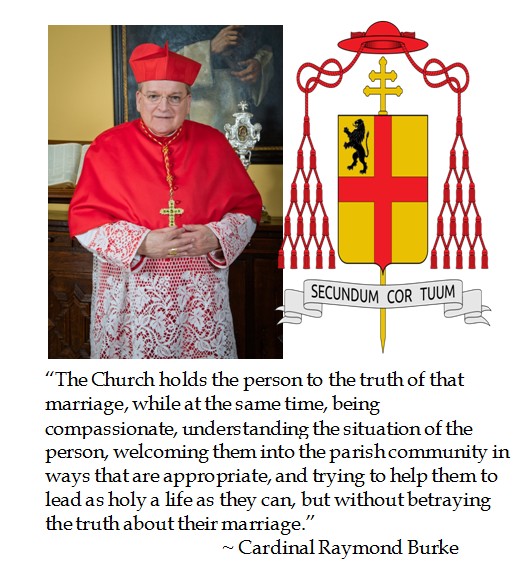
- There were some slights in naming Synod Fathers who were not invited back to participate who held a more traditional line (such as Cardinal Raymond Burke) whereas an influential emeritus Bishops over the voting age who aligned with the New Mercy (namely Cardinal Kasper) participated.
- Synod 2015 Father Australian Cardinal George Pell was absolutely certain that the final report of the Synod on the Family made no reference to communion to divorced and remarried Catholics. Yet at the same time, German Conference of Bishops President Cardinal Reinhard Marx praised the Synod for being a "real step forward" in pastoral care for divorced and civilly remarried Catholics. Judging from Amoris Laetitia and the emphasis on Pope Francis' footnote 351 as being the authentic key for interpretation, it seems that the Synod Fathers' deliberations were moot.
- Pope Francis named Archbishop Vincenzo Paglia and Monsignor Pierangelo Sequeri to lead the John Paul II Institute for Studies on Marriage and the Family. Paglia has expressed opinions which endorse Kasperian Gradualism and is eager to implement Amoris Laetitia. This is significant because if the is just a pastoral option, then implementing it sounds more systematic.
Some longstanding virtues of the Catholic faith is to have surety of authority in Scripture, Holy Tradition and the Magisterium. Likewise, in the Roman Church, there has been a uniformity in implementation. Sacraments are not mere signs but efficacious means of grace for those spiritually disposed to receive them.
Amoris Laetitia, the conduit for the New Mercy, may break that mold and many of the faithful many find themselves ruing the Spirit of
Amoris Laetitia.
It is a pity that there is concerted effort by leaders in the Church to take an ultramontainist approach to implementing
Amoris Laetitia, when the interpretation via a footnote goes far beyond what the Synod of the Family's final report held, and also seem to contravene a hard teaching of Jesus Christ.


 One of the characteristics of Pope Francis' reign is the injection of secular progressive politics into papal pronouncements. In Laudato Si' (2015), Pope Francis implored world leaders to approve the Paris Climate Change Accords. Pope Francis' visit to the Mexican-US border was a pointed ploy to champion open borders, counter to the platform of then candidate now President Donald Trump. Even Pope Francis' annual announcement for World Communication Day railed against "fake news".

 Paragraph 3 of Amoris Laetitia indicates that the document was not doctrinal and was intended to start the conversation. The controversy over Amoris Laetitia involves footnote 351 regarding Paragraph 305 which suggests that there might be some pastoral means of curing irregular second marriages. But Pope Francis has refused to answer dubia's regarding the implementation. And progressive powers in the Church are attempting to steamroll their will, in a jesuitical manner, speaking with great force but not having the facts on their side.