Showing posts with label Audio. Show all posts

Wednesday, February 3, 2021

Watering Down Baptism?

 While listening to Personally Speaking, a  Catholic interview program hosted by Monseigneur Jim Lisante, the prelate host shared sua sponte that he recently was approached by two lesbians who sought to have their child baptized.  Despite being turned away at two other parishes, the priest proclaimed to the couple:  “There isn’t anything in the bible about being gay so it must be OK” thus he consented to perform the sacrament.

The cleric’s superficial scriptural analysis speciously seems to ignore Jesus’ perspective on marriage in MT 19 as a married man and woman become one flesh. That passage clearly does not include alternative arrangements.   But the conundrum is on the propriety of baptizing a child to parents who manifestly are living contrary to the teachings of the church. 

While I appreciate the pastoral inclinations, the scenario calls into question the rationale for the sacrament of initiation and what is involved in infant baptism. Ideally, baptism claims the person as a child of God with an indelible mark on the soul. But an infant is unable to make baptismal promises, so those proclamations of faith are made by parents and godparents. Thus, pastoral discernment is required of the parents and godparents

Canon 1255 anticipates that the faith promise given infant baptism be supplemented by the parents, godparents and community.  In Acts 2:38 St. Peter exhorts us to “Repent and be baptized” which requires a metanoia (i.e. turning away from sin) in those professing the faith.

Practically speaking, the faith must be nurtured by the practice in the home church as well as with the People of God. The difficulty is when parents are living lives that are manifestly and publicly contrary to the tenants of the faith.

Those inclined to seek the mercy of God would surely say that an innocent child should not be punished for the sins of the parents.  But baptism involve promises made in rearing the child in the faith.   In this scenario, we can assume that they are living as a same sex couple and have pride in their lifestyle.  If one of the couple is biologically the mother, it raises issues about artificial insemination or procreation outside of marriage. This would mean that a child would be expected to be raised in the faith by a couple co-habitating outside of sacramental marriage and with orientations that the church teaches are disordered? 

 Despite Monseigneur Lisante’s claims, the Church in Canon 2357 considers homosexual acts as intrinsically disordered.   It is unclear if the couple was civilly married but the Church does not recognize such unions as being covenantial or sacramental. Perhaps the couple was not church going and those pastors deemed the sacrament of baptism being used as a ritualistic rite of passage rather than a conferral of grace.

Near the beginning of Pope Francis’ papacy, the Holy Father chided young priests to not become “little monsters” doggedly adhering to doctrine but instead to focus on compassion, evangelization and inclusion.  In that spirit, pastors may be reluctant to turn away anyone from the Church, even if adherence to baptismal promises made for them seem tenuous so as to see if takes hold. This calls to mind the conversion story of Fr. Donald Calloway who was baptized at age ten at the behest of Episcopalian kin even though his parents were not practicing their faith.  The only thing that he remembered from his baptismal sacrament of initiation was the donuts they eat afterwards.  Hearing his hair raising testimony, the graces of baptism did not take from merely that liturgical ritual.  Is it merciful to give the impression that one is saved by baptism but has no context to living properly as a Catholic Christian?

Pope Francis’ encyclical, Amoris Laetitia, attempted to reconcile the practice of the Catholic faith with the Modern Family.  Pope Francis declared that marriage was between a man and a woman for life (para. 62), same sex unions can not be equated with marriage (para. 52) and that education is the of a child is the “primary right” of parents (para. 84).  It is hard to believe that the child would be brought up in the ways of the church in the aforementioned scenario, which argues against  a profligate administration of baptism.

Pro arguendo, one could attempt to apply the logic of Chapter Eight of Amoris Laetitia in this instance.  After all, Pope Francis opined that pastors ought not throw moral stones and be done with irregular situations.  In footnote 351, the Holy Father sought to reconcile those in irregular marriages (Catholics civilly remarried after a divorce without obtaining an annulment) with the Church through a circuitous procedure in lieu of canon law.  

This alternative approach required extensive pastoral counseling for the couple so they could understand the wisdom of the Church and conforming their lives to the teaching.  In conforming irregular marriage to the norms of the church, the couple would need  to be catechized and gain an informed conscience. If children were a consideration and couples could not easily separate, so they would be enjoined from marital relations in order to receive the sacraments. And the couple would be encouraged to join another parish so as to avoid the appearance of scandal.  Of course, that is asking a lot. But the Gospel exhorts us: “The kingdom of God is at hand. Repent, and believe in the gospel.” 

So how would this Amoris Laetitia logic be applied to parents of a child seeking baptism who are flagrantly living their lives contrary to Church teachings?  That’s the rub.  Those making the baptismal promises are more than falling short of virtue.  They are publicly living their lives contrary to the teaching of the Faith.  Amoris Laetitia anticipates some metanoia as well as a resolve to sin no more.  Is it reasonable to expect the child to be raised under the Church’s precepts, particularly with the Home Church defies the theology of the body and a sacredness of the covenant of marriage?  

In America, we fret about the lack of Sunday Mass by many baptized Catholics  and of the glaring lack of understanding of fundamental precepts of faith (e.g. the Real Presence in the Eucharist). So many poorly catechized Catholics are poached by Evangelical denominations since they hunger for the divine, but are sacramentalized but not catechized.  So much for the fruits from the Church of Nice. For seekers of Divine Truth, it is disheartening if they discover that were holy fools for playing by the rules because mercy to the unrepentant overrides all.

While it sounds merciful to baptize a child from a proud lesbian couple, sadly it seems that the child would be left as a spiritual orphan through a perfunctory ceremony which waters down the sacrament.


Thursday, January 25, 2018

On the Politicization of Church Life

Cardinal Raymond Burke on the Politization of Church Life under Pope Francis

Cardinal Raymond Burke gave an extended interview with Christopher Altieri for "Thinking With the Church" about matters of controversy among Catholics.  Burke's interview was recorded as a podcast and the transcript was published in the Catholic World Reporter. The Patron of the Sovereign Military Order of Malta expressed anguish that some consider his request to the Holy See for clarifications (dubia) about the  apostolic exhortation Amoris Laetitia (2016) are motivated to create a schism in the Catholic church.  

Cardinal Burke is concerned that the interpretation and application of Amoris Laetitia contradict long standing traditional teachings on the Sacrament of Marriage.  While Cardinal Burke scrupulously avoided ideological labels in his Altieri interview, he noted the Bishop of Malta's innovation regarding irregular second marriages, which clearly are progressive in nature.


One of the characteristics of Pope Francis' reign is the injection of secular progressive politics into papal pronouncements.  In Laudato Si' (2015), Pope Francis implored world leaders to approve the Paris Climate Change Accords.  Pope Francis' visit to the Mexican-US  border was a pointed ploy to champion open borders, counter to the platform of then  candidate now President Donald Trump. Even Pope Francis' annual announcement for World  Communication Day  railed against "fake news"


Pope Francis' advocated a journalism of peace, which the Holy Father defined as:

A journalism created by people for people, one that is at the service of all, especially those – and they are the majority in our world – who have no voice,” A journalism less concentrated on breaking news than on exploring the underlying causes of conflict, in order to promote deeper understanding and contribute to their resolution by setting in place virtuous process. A journalism committed to pointing out alternatives to the escalation of shouting matches and verbal violence."

A true faith ought to be challenged and should not be confined to the sanctuary of the Church. There is the danger , however, that the Catholic faithful are being shepherded to take sides on secular political issues which are outside of the aura of competency of the Petrine office) and sometimes seem counter to traditional church teachings).  Those who object to this progressive polarization and stand fast to the Magisterium have increasingly been scorned, ostracized or dismissed as getting with today's program, even if the innovation is not magisterial.


For example, Chicago's Archbishop Blase Cardinal Cupich interpreted Amoris Laetitia as being a development of doctrine which the Petrine office has loosened requirements when pastorally addressing irregular marriages. But the apostolic exhortation did no such thing.  

Paragraph 3 of Amoris Laetitia indicates that the document was not doctrinal and was intended to start the conversation.  The controversy over Amoris Laetitia involves footnote 351 regarding Paragraph 305 which suggests that there might be some pastoral means of curing irregular second marriages.  But Pope Francis has refused to answer dubia's regarding the implementation. And progressive powers in the Church are attempting to steamroll their will, in a jesuitical manner, speaking with great force but not having the facts on their side.

As we grapple with the politicization of Church life, we ought to heed 16th Century Lutheran theologian Peter Meiderlin's wisdom that we ought to have "[U]nity on necessary things, liberty on dubious things and charity in all things." 


Thursday, February 9, 2017

BOOK REVIEW: Churchy by Sarah Condon


Churchy [Mockingbird 2016 180 p.]  is a  non-fictional version of chick lit which shares Sarah Condon’s unvarnished personal vignettes that seeks to lead readers towards retrospective religious reflections. It is published by Mockingbird Ministries, which strives to connect the Christian faith with the realities of everyday life in fresh down-to-earth ways. No one will mistake Sarah Condon’s Churchy musings as mundane faith history.


"St." Flannery O'Connor
Churchy’s subtitle is “The Real Life Adventures of a wife, mom and priest”.   Truth be told, she thinks that the real title ought to have been: “Churchy Prodigal Daughter Who Is the Worst” which packs in a lot of theology, but those leitmotifs were already taken. Clearly, Condon is influenced by Southern Goth, as demonstrated by her reverence to “St.” Flannery O’Connor. This honorific should be no surprise as she attributed sainthood to Whitney Houston in prior Mockingbird articles 

Condon is an Episcopal priest who is married to another Episcopal priest pastoring a  parish in Houston Texas.  Sarah Condon’s ministry has included hospital ministry, in the dreaded “Liver Floor” filled with alcoholic patients in need of organ donations.


Rev. Sarah Condon 
After hearing Sarah speak at a retreat, I was prepared for her irreverent, earthy rhetoric (but the harshest epithets published were “holy shit” and “bullhockey”) to accompany her vivid story telling.  I noted that a couple of the vignettes were reworked into part of her speaking repertoire.  


Since my Roman Catholic tradition neither has many married clergymen (much less priestesses), I was interested in understanding her vocation as well as appreciating the strains of family life with clerical duties.   Honestly, this angle was not clear.  Most of Churchy seemed drawn from the lens of a Churchy mother who was wont to extrapolate theological truths from the quotidian.

Condon’s view on her vocation was not crystal clear. In the introduction, she noted that: 


“Josh [her husband] and I are both Episcopal priests. But most Sundays, you will see me in the pews with my children. On occasion, I stand behind the altar and celebrate communion.”  

As someone who understands sacramentality as a key distinction between the laity and the ordained, it seemed like  a nonchalant approach to take a priestly vocation yet to only feel obliged to “stand behind the altar” from time to time. 

Regarding her role as an off hours hospital chaplain, Condon conceded that she often hears the awkward inquiry: “What do you do for a living?”  She modestly asserts that she utters  a ratio 70%-30% stupid to wise things while “bumbling around” hospital wards. This underplays  the vital mission of just being present to  those who may be on the precipice of death. Such companioning in Christ echoes tenants of Ignatian spirituality which Pope Francis has been championing during his papacy.

In the chapter which contains the Cereal Aisle Stranger section, Sarah Condon wrote: 


“And there is the issue of me telling strangers what my husband and I do for a living while standing in front of a row of Fruit Loops.” 


Kind of surreal small talk in the Cereal Section. Yet the way that Sarah described the query as being about what they did for a living rather than refer to their priestly vocations or ministries. That particular turn of phrase niggled at me.

Condon’s later  reflections on her household concluded: 


“Meanwhile, I bring in some income with writing and part-time ministry work, put food in the crock pot, spend an incredible amount of time with my children and talk on the phone to my mom, a lot.”  

Sarah’s description of her role is a dose of honesty mixed in with a good measure of self-deprecating humor. However, it begs a poignant question –Should ordination be deemed just a part time job or a vocation of sacerdotal service to the people of God?  It is certainly unusual for a priest to be married to a priest while raising a family. I again wonder about how there can be sufficient self sacrifice to the needs of the faithful. Can active priests really be part-timers?

Irregardless of that dialectic, Sarah Condon does not easily fit into feminist stereotypes. In reflecting on her early attitudes towards her marriage that:


“[I]t was easier to think of myself as a woman liberated from role of ‘wife’ than it was to think of myself as a co-signer in covenant of sickness and health.” 

That liberated attitude along with being a priest being married to a priest might lead one to believe that Condon had totally signed unto the feminist agenda. Yet Condon rues the Episcopal Church’s expectation that of a  feminist art installation as a spiritual superhero who be both a real mother as well as a mother in ministry. Sarah also chaffed at feeling as if women priests are figuratively shoved through male shaped boxes, as exemplified as being required to complete an ordination exam as she was in the midst of a first trimester miscarriage. 

Condon does work in some theological concepts in layman’s terms.  She jars her readers attention with the theological precept that: “Humanity is a clown parade of jackwagons.”  Her vivid illustration of low anthropology contrasted with high Christology. This highlights how God loves us flawed sinful men and women but his only Son redeemed us through his Cross and resurrection. She also explores how “If your boss thinks you’re awesome then you’ll become awesome has a nexus with the imputed righteousness of Christ. 

There were two poignant thoughts which I gleaned from Sarah Condon’s Churchy self-reflections.  As she was being shadowed as a hospital chaplain, she was ministering to a family who had decided to withdraw life support for a dying loved one.  Condon wondered why her mentor returned to the terminal patient’s room and whispered consoling phrases into her ear.  That taught her that she was at the most important time in a person’s life–the deathbed.  Moreover, Condon noted that hearing is the last sense to go, so it is always worth whispering love into the ears of the dying. It called to mind St. Faustina Kowalska’s recommendation to pray the Divine Mercy Chaplet at a death bed.

The other striking idea Condon borrowed from her friend's bon mot.   While at a ecumenical pastors meeting in New York City, they were discussing which were their "target audiences" for planting ministries. Many participants suggested going after youth groups. But her friend puckishly suggested: “We’d like to get more middle-aged divorced women”, which underlined the need to minister to the broken-hearted. This vision sees church as a field hospital tending to those wounded and suffering from life’s battles. 

While I suspect that I was not part of Churchy’s “target audience”, I can appreciate how Sarah Condon’s witty writing desultory anecdotes and contemporizing gospel lessons might inspire a modern metanoia.  To wit, Lady Gaga  sought Rev. Sarah Condon to hear her preach before performing at the Houston Super Bowl.   


Sarah Condon  should be commended for writing Churchy as an honest soul searching book as well as expressing a willingness to see God in all things

Friday, April 15, 2016

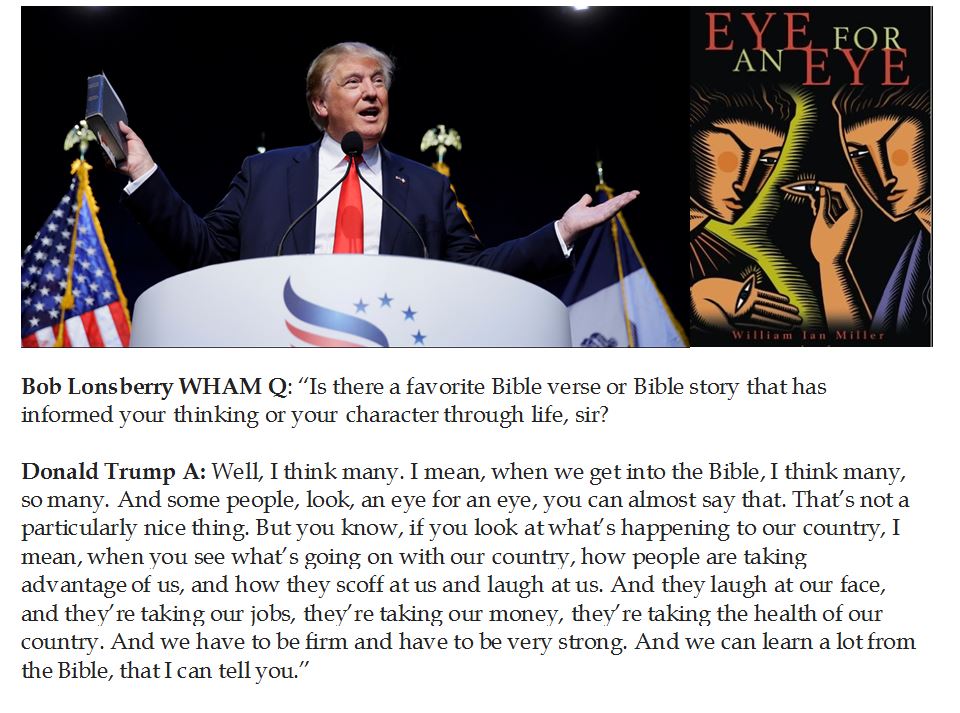
Telling--Trump's Favorite Scriptural Passage Is Lex Taliones

Donald Trump's Favorite Bible Verse Eye for an Eye

In a telling interview with a Rochester, New York radio station, Republican Presidential front-runner Donald Trump revealed the Bible passage which has most informed his thinking-- An Eye for an Eye.


Naturally,  Mr Trump did not spew out the exact scriptural reference, so for all he knew it was the Code of Hammurabi instead of the Book of  Levitucus 24:19-21.   It's not exactly something that one would hear about from Two Corinthians (sic). Nor did Trump appreciate how St. Augustine marked it as a controversial passage showing the vengeful nature of the Old Testament. 

An eye for an eye is known as the Lex Taliones (Latin for Law of the Talon)  for a law of retaliation which today has particular relevance in tort law, for translating non-economic losses into money.

Considering Trump's public persona, which craves flattery but lashes out when others' oppose him and his persistent pugilism, Trump's memory verse rings true.  Trump's candid scriptural citation certainly peers into what burnishes his soul. 

Elections certainly ought to be about vetting ideas of how to govern the polity.  But they can also act as a measure of a man's character.  To install a leader of the free world who swears by lex taliones may make being a pirate commonplace.


Cavaet emptor.  

Tuesday, July 16, 2013

Assessing Atheist Archetypes


The Guardian recently publicized a study out of the University of Tennessee which characterized six types of atheists.

Amongst the 1,153 atheists living in southeastern states, 37% of those surveyed were said to be “intellectual atheists”.  These “intellectual atheists” are characterized as well educated people who are interested in religion but who are non-believers.  


Jacques Derrida caricature
Such intellectual atheists are comfortable in secular societies which reflects Jacques Derrida’s deconstructionist conceit which rejects an exclusive hermeneutic of truth.  This is distinct from “non-theists” who live life without regard to considering transcendental truths. 


The "anti-theists" comprised 14% of the study.  These anti-theists colloquially can be characterized as the “angry, argumentative, dogmatic type”.  This group aggressively argues for their belief or non-belief system.  

Some sympathizing with secular humanism think that the 14% was too high a figure.  But as in individual who is inclined to engage in metaphysical musings with others, it seems like a low figure.  It may be that dogmatic and narcissistic anti-theists are more vocal in evangelizing their anti-theist opinions.  

Another subcategory of atheists are “ritual atheists” who may not themselves believe but believe that society can be enhanced by ritual and tradition.  These ritual non-theists  can rationalize their assent to religious rituals  for others as a means to live life and achieve happiness rather than a route to transcendental liberation.  


A similar class of atheists are “seeker agnostics” who can best be described as “spiritual but not religious”.  Theists may jibe that “seeker agnostics” are atheists who have lost their faith.  Much of American Jewry seems to align itself as ritual atheists or seeker agnostics, but it would seem more cultural affinity rather than spiritual contemplation.


A final portion of the atheist population can be labeled “activists”, as atheists who hold strong ethical and environmental opinions which activists do not perceive are not rooted in religion.  Of course, a deeper contemplation of these mainly western values begs the question from where these ethos are derived. 

These six atheistic archetypes does not include every opinion, Richard Dawkins, the author of The God Delusion (2008), argues that religious education should be a part of a literary education in state schools.  Dawkins contends that the King James Version translation of the Bible (1611) has inspired 129 biblical phrases that are instantly recognizable to any cultured English speaker. 


 But before one is lead to believe that Dawkins might be a “ritual atheist”, Dawkins  endorses the effort to put  King James Bibles in state schools to show that scripture is not a good guide to morality. 

h/t: The Guardian
         Bizarro.com

Saturday, April 27, 2013

Snips of Truth About Ignoring Infanticide in America


Some may be scandalized by comparing the unsavory actions of abortionist Kermit Gosnell and President Barack Obama.  Yet the facts hold out that as a legislator in the Illinois Senate, Mr. Obama twice opposed the Born-Alive Infant Protection Act.

In 2008, Presidential Candidate Obama  lashed out against "liars" when his legislative positions were questioned.  He issued a statement that he was deeply insulted and offended as the proud father of two girls that he was in favor of infanticide.  Even the Washington Post would award Mr. Obama four pinocchios for this misleading statement, as Obama was impeached on a Christian Broadcasting Network video, but that was so four years ago. 


That if that fetus, or child, however you want to describe it, is now outside of the mother's womb and the doctor continues to think that it's non viable but there's lets say movement or some indication that they're not just coming out limp and dead that in fact they would then have to call in a second physician to monitor and check off and make sure that this is not a live child that could be saved?

The salient point is that the requirement to have a second physician on call was an undue burden that would inhibit access to an abortion.   Furthermore, Mr. Obama dismisses the notion that physicians would not attend to mistakes and have a fetus outside of the mother's womb that was viable.

Consider the gory facts exposed in the Gosnell capital murder case in Philadelphia.  Abortionist Gosnell's special technique, which he instructed other unlicensed staff in his office to also perform, was to snip the spinal cord of a just born-alive child in an illegal late term abortion so that it "ensured fetal demise".  Does that give Mr. Obama some cause for pause?


Mr. Obama's contradictory comments make as much sense as when President Obama recently said "God Bless Planned Parenthood"  to a conference of the nation's largest abortion and "family planning" providers.  


The media continues to ignore the inconsistencies in Obama's extreme abortion stance as well as the details of the Kermit Gosnell trial because facts challenging their secular shibboleths exposes the hypocrisy of doing everything "for the children" and exposes the callousness of their "choices". And to add insult to mortal injury,  both Gosnell and Mr. Obama justify their actions to help the poor and marginalized, with little regard for the law, ethics, or the ultimate consequences.

Tuesday, April 2, 2013

An Easter Message for Obama's Ears

President Obama and his family walked across Lafayette Square to attend Easter Sunday service at St. John’s Episcopal Church in Washington, DC.


The presider was the Reverend Luis Leon, who also gave the closing benediction at President Obama’s second inauguration. 


Mr. Obama & Rev. Luis Leon at DC's's St. John's Episcopal Church 


Unlike at the ceremony on the Mall, where Leon’s stated goal was to bring people together, Leon chose to preach politically partisan on the holiest day of the Christian calendar.  Leon preached from the pulpit:


The captains of the religious right are always calling us back, back back. For blacks to be back in the back of the bus, for women to be back in the kitchen, for gays to be in the closet and for immigrants  to be on their side of the border...What you and I understand is that when Jesus says you can’t hang onto me, he says you know it’s not about the past, it’s not about the before, it’s not about the way things were but about the way things can be in the now.

Really? Please cite some contemporary examples of captains of the religious right calling blacks to be at the back of the bus.  Leon did not do so during his Easter sermon.

***
The Easter message can be understood with its  parallel to the Jewish Passover. The children of Israel were freed from their slavery in Egypt by Yahweh’s power and they were put on the path to the Promised Land.  Jesus Christ’s sacrificial death on the Cross conquered the ultimate wages of spiritual slavery to sin–death.  

It might be worth considering if Rev. Leon’s sermon  was truly uplifting or perpetuating continued political bonds dressed up in Easter finery or spurious scriptural sanction.  The answer may be found in Rev. C.L. Bryant's documentary Runaway Slave.   Alas, the message might not be a revelation as much as a lamentation.

SEE MORE at DCBarroco.com 

Wednesday, March 20, 2013

Gerald Manley Hopkins Welcomes Spring

Nothing is so beautiful as spring—
  When weeds, in wheels, shoot long and lovely and lush;
  Thrush’s eggs look little low heavens, and thrush
Through the echoing timber does so rinse and wring
The ear, it strikes like lightnings to hear him sing;
  The glassy peartree leaves and blooms, they brush
  The descending blue; that blue is all in a rush
With richness; the racing lambs too have fair their fling.
What is all this juice and all this joy?
  A strain of the earth’s sweet being in the beginning
In Eden garden.—Have, get, before it cloy,
  Before it cloud, Christ, lord, and sour with sinning,
Innocent mind and Mayday in girl and boy,
  Most, O maid’s child, thy choice and worthy the winning.

Spring (1918)


Tuesday, December 25, 2012

Anecdotic Accounts Of The Incarnation

Madonna of Port Lligat, Marquette University

During an excellent Christmas Eve homily from a Redemptorist priest, we were challenged to reconsider the miracle of the Incarnation, both from our own vantage points and reflecting on the mystery through great art.

As for a contemporary take on the Nativity, I must commend a Portuguese advertising agency for coming up with an anachronistic retelling of the Greatest Story:


Another approach to better appreciate the miracle of the Word becoming flesh is through depictions in great art.  Hence the Madonna of Port Lligat (1949) by Salvador Dali from the Marquette University Haggerty Museum of Art.  Fr. Jim Wallace, C.Ss.R., also commended a short poem by the American poetess Denice Leterov:  “On the Mystery of the Incarnation”


It's when we face for a moment
the worst our kind can do, and shudder to know
the taint in our own selves, that awe
cracks the mind's shell and enters the heart:
not to a flower, not to a dolphin,
to no innocent form
but to this creature vainly sure
it and no other is god-like, God
(out of compassion for our ugly
failure to evolve) entrusts,
as guest, as brother,
the Word.

That’s a lot to chew on while savoring some tryptophan inspired shut eye.

A “Happy Christmas” to all and to all a good night.

Monday, October 22, 2012

Pope John Paul II on Faith

John Paul II

Today is the liturgical feast day for Pope St. John Paul II.   It is worth remembering the encouraging words that the new pope uttered during his installation in 1978.  The exhortation to "Open the doors wide to Christ" was delivered to a Church which was adjusting to the changes of Vatican II and world in upheaval.


O God, who are rich in mercy
and who willed that the blessed John Paul II
should preside as Pope over your universal Church,
grant, we pray, that instructed by his teaching,
we may open our hearts to the saving grace of Christ,
the sole Redeemer of mankind.
Who lives and reigns
.

Saturday, September 1, 2012

Salvific History Sand Sculptures

Salvific History sand sculpture by Randy Hofman, Ocean City, MD 2009   [photo: BD Matt]

Randy Hofman, a 61 year old Ocean Pines, MD, has been making biblical sand sculptures to vacationers on the Delmarva shore since 1974 and Hofman has been doing it singularly since 1981. From the beginning of April to the end of October, it is Hofman's mission to bring the Christian message to the Ocean City boardwalk.  During the winter, Hofman concentrates on his paintings, but also does wood carvings and prints.

Randy Hofman works on a Sand Sculpture

Hofman estimates that it can take up to 15 hours to construct his elaborate biblical sand sculptures as he only uses a square shovel and a crab picking knife. This is remarkable for a sand canvas that can be 10 feet tall and 40 feet long.  Over the years, Hofman has done well over a thousand spiritual sand sculptures


Hofman never abandons a project and can sometimes work until dawn to complete the work.   While he does put a coating of Elmer's glue to give the sand sculpture some longevity, it is still prone to the elements and can be marred by a heavy rain or a crass carousing delinquent.

Hofman made Christian themed sand sculpting into a full time ministry in 1981. He also became an ordained minister in 1985.  He will occasionally evangelize as he works with the shifting grains of sand and will also engage with inquisitive passers-by.

 Hofman seems to revel that his handiwork prompts kids to ask their parents what it is all about.  The artist opined: ""I want it to click so that even someone who is spiritually ignorant can understand."


Divine Forgiveness by Randy Hofman (2009)   [photo: BD Matt]
Gratitude for Sacrifice on the Cross by Randy Hofman (2009)   [photo: BD Matt]


Glorified Resurrected Jesus  by Randy Hofman  (2009)   [photo: BD Matt]

See more spiritually themed sand sculptures at CalamityDC's Pinterest site
h/t: Randy Hofman


Wednesday, July 11, 2012

Special Mass Text?


During the closing mass for the Fortnight for Freedom at the National Basilica of the Immaculate Conception in Washington, DC, Baltimore Archbishop William Lori followed a special rubric for the mass.  Archbishop Lori asked the gathered faithful to text Freedom or Libertad to 377377.

                                Archbishop Lori's Special Mass Texting (sic.)

The assembled Catholic congregation should be happy that they weren't worshipping at Westminster Presbyterian in Burbank, California.