

Showing posts with label Easter. Show all posts
Showing posts with label Easter. Show all posts
Monday, March 28, 2016

Tuesday, April 7, 2015
Barack Obama Questions Christian Love at White House Easter Breakfast

As Christians continued to celebrate the miracle of the Resurrection at a Tuesday Easter Prayer Breakfast at the White House, President Barack Obama could not resist poking at the Nazarene's faithful. While Mr. Obama's remarks does echo some of the Paschal message, he flippantly questioned some perceived deficiencies in Christian Love (presumably an oblique reference to Indiana's RFRA law controversy).
It seems rather rude for the President to turn a prayer breakfast of the most important holiday into a partisan punch line. Unfortunately, this is not uncharacteristic of the Obama Administration. Last year, President Obama "spontaneously" called on the controversial gay Episcopal Bishop Vichy "Gene" Robinson for a closing prayer.
What was striking about President Obama's 2015 Easter Prayer Breakfast remarks is that he failed to acknowledge the massacre and martyrdom of 148 Christians at Garissa University College in eastern Kenya on Maudy Thursday by Islamist terrorists. Of course, when Mr. Obama did address the latest Kenyan atrocity, the President failed to mention the faith of both the "folks" who were slaughtered as well as the creed which inspired the dastardly deed. In addition, when President Obama spoke about the bloody beheadings of 21 people in Libya by ISIS he referred to them as "Egyptian citizens" rather than as Coptic Christians which prompted their martyrdom.
 |
| Icon of the "New Martyrs" by Tony Rezk. Coptic Pope Tawadros II declared Feb. 15th their feast day |
Of course, clearly identifying victims of the contemporary jihad by radical would wreck the impression that Christianity is about the Crusades and the Inquisition as President Obama alluded in his 2015 National Prayer Breakfast remarks.
Sunday, April 5, 2015

 </
</Saturday, April 4, 2015

Sunday, May 4, 2014
Still Digesting President Obama's Easter Prayer Breakfast Remarks

President Obama's remarks for the 2014 Easter Prayer breakfast ranged from a somber recounting of a deadly attack on a Kansas Jewish Community Center, a summing up of the Christian Easter message, touting the President's meeting with Pope Francis at the Vatican and POTUS' playful prayer.
Sunday, April 20, 2014
Happy Bunnies Bringing Easter Joy
The rabbit has long been associated with Easter. Pagan Germanic tribes worshiped Eostroa, a Teutonic goddess of fertility, whose symbol was a rabbit around the vernal equinox. The Catholic church syncretically incorporated this traditions in the 15th century with Christian overtones. The fecund fertility of the rabbit reaffirmed how the feast of the resurrection brought new life to the world. Moreover, medieval people thought that the rabbit could reproduce without losing its virginity, thus it was a reminder of the Blessed Virgin Mary.
The Easter Bunny originated among German Lutherans in the late 17th century as the Easter Hare acted as a judge as to whether children were naughty at the start of Eastertide. Pennsylvanian Dutch folklore in America had the Osterhase giving gift of colored eggs that they made in their caps and bonnets only to the good children. Germans were also the first to make chocolate Easter eggs in the 19th century. The tradition spread in America that the Easter Bunny delivered baskets of treats to children on Easter. Walt Disney built upon this folk tradition with his Silly Symphonies Funny Little Bunnies (1934) short.
But what would make these funny bunnies really happy is Bos Keun a seasonal Passbier (Easter Beer) brewed by Brouwerij De Dolle Brouwers in Essen, Belgium.

The Easter Bunny originated among German Lutherans in the late 17th century as the Easter Hare acted as a judge as to whether children were naughty at the start of Eastertide. Pennsylvanian Dutch folklore in America had the Osterhase giving gift of colored eggs that they made in their caps and bonnets only to the good children. Germans were also the first to make chocolate Easter eggs in the 19th century. The tradition spread in America that the Easter Bunny delivered baskets of treats to children on Easter. Walt Disney built upon this folk tradition with his Silly Symphonies Funny Little Bunnies (1934) short.
But what would make these funny bunnies really happy is Bos Keun a seasonal Passbier (Easter Beer) brewed by Brouwerij De Dolle Brouwers in Essen, Belgium.
These Flemish "Mad Brewers"produce Bos Keun (meaning "rabbit in woods") is a blond Belgian strong beer which is 7% ABV that uses pale malt, Goldings hops, candy sugar and is bottle conditioned. Let the children enjoy their chocolate Easter eggs and let the beer connoinsseurs "Paas" with some Bos Keun

Wednesday, April 16, 2014
Al Sharpton on Easter

The Reverend Al Sharpton gave an unusual Easter message on the Tom Joyner Show. Sharpton tried to be ecumenical to reach out to Christians, Jews and atheists with an anti-materialist message to remember the reason for the season.
Sharpton alluded to every man challenges where people feel crucified. Sharpton encouraged folks to rise above their suffering and not become like the disease they fight. Sharpton closed his secular preaching by alluding to an alleged crucifixion of Barack Obama. The Reverend claimed that he was not comparing Obama to Jesus but for every crucifixion there is a resurrection for those who believe.
So the question is on the orthodoxy of Reverend Al Sharpton's Easter message that to every crucifixion there is a resurrection for those who believe, so rise above your unearned suffering.
For those who want to hear more of Reverend Sharpton's preaching, you will not find him in church but on PoliticsNation, 6 PM et on MSNBC.
Tuesday, April 9, 2013
Peeps Awaiting a Confectionary Resurrection
As the Easter Octave has come to an end, and most of our baskets are empty from the confectionary delights which celebrated the Feast of the Resurrection. So it may be a good time to highlight the winner of the Washington Post's seventh Peep Diorama competition.
Leslie Brown and Lani Hoza of Charlottesville, Virginia cooked up a tongue in cheek memorial for the loss of a beloved mass market treat: "Peeps mourn their Peeps: Twinkie Rest In Peace".

This dirgeful diorama also honors other tasty treats involved in the union killing of Hostess in November 2013.

It is unclear what relation the Peeps were to Twinkie the Kid.

But in the spirit of Eastertide--the Twinkie will also be resurrected. Apollo Global Management and Metropoulos & Co. bought the rights for Twinkies for $410 million. Dean Metropoulos is renowned for repositioning tired brands like Pabst Blue Ribbon. The problem with Hostess is that the bankruptcy wiped out Twinkie manufacturing and distribution. They promise that the Twinkies and other snacks will return to store shelves by the summer 2013.
Until then, we can appreciate the Peeps diorama. After all, if one hasn't consumed a Peep for a day, it is so stale that it will seemingly last forever like Twinkie, so it well suited for diorama art.
h/t: Washington Post
Leslie Brown and Lani Hoza of Charlottesville, Virginia cooked up a tongue in cheek memorial for the loss of a beloved mass market treat: "Peeps mourn their Peeps: Twinkie Rest In Peace".

This dirgeful diorama also honors other tasty treats involved in the union killing of Hostess in November 2013.

It is unclear what relation the Peeps were to Twinkie the Kid.

But in the spirit of Eastertide--the Twinkie will also be resurrected. Apollo Global Management and Metropoulos & Co. bought the rights for Twinkies for $410 million. Dean Metropoulos is renowned for repositioning tired brands like Pabst Blue Ribbon. The problem with Hostess is that the bankruptcy wiped out Twinkie manufacturing and distribution. They promise that the Twinkies and other snacks will return to store shelves by the summer 2013.
Until then, we can appreciate the Peeps diorama. After all, if one hasn't consumed a Peep for a day, it is so stale that it will seemingly last forever like Twinkie, so it well suited for diorama art.
h/t: Washington Post
Tuesday, April 2, 2013
An Easter Message for Obama's Ears
President Obama and his family walked across Lafayette Square to attend Easter Sunday service at St. John’s Episcopal Church in Washington, DC.
The presider was the Reverend Luis Leon, who also gave the closing benediction at President Obama’s second inauguration.
Unlike at the ceremony on the Mall, where Leon’s stated goal was to bring people together, Leon chose to preach politically partisan on the holiest day of the Christian calendar. Leon preached from the pulpit:
Really? Please cite some contemporary examples of captains of the religious right calling blacks to be at the back of the bus. Leon did not do so during his Easter sermon.
***
It might be worth considering if Rev. Leon’s sermon was truly uplifting or perpetuating continued political bonds dressed up in Easter finery or spurious scriptural sanction. The answer may be found in Rev. C.L. Bryant's documentary Runaway Slave. Alas, the message might not be a revelation as much as a lamentation.
The presider was the Reverend Luis Leon, who also gave the closing benediction at President Obama’s second inauguration.
 |
| Mr. Obama & Rev. Luis Leon at DC's's St. John's Episcopal Church |
Unlike at the ceremony on the Mall, where Leon’s stated goal was to bring people together, Leon chose to preach politically partisan on the holiest day of the Christian calendar. Leon preached from the pulpit:
The captains of the religious right are always calling us back, back back. For blacks to be back in the back of the bus, for women to be back in the kitchen, for gays to be in the closet and for immigrants to be on their side of the border...What you and I understand is that when Jesus says you can’t hang onto me, he says you know it’s not about the past, it’s not about the before, it’s not about the way things were but about the way things can be in the now.
Really? Please cite some contemporary examples of captains of the religious right calling blacks to be at the back of the bus. Leon did not do so during his Easter sermon.
***
The Easter message can be understood with its parallel to the Jewish Passover. The children of Israel were freed from their slavery in Egypt by Yahweh’s power and they were put on the path to the Promised Land. Jesus Christ’s sacrificial death on the Cross conquered the ultimate wages of spiritual slavery to sin–death.
It might be worth considering if Rev. Leon’s sermon was truly uplifting or perpetuating continued political bonds dressed up in Easter finery or spurious scriptural sanction. The answer may be found in Rev. C.L. Bryant's documentary Runaway Slave. Alas, the message might not be a revelation as much as a lamentation.
SEE MORE at DCBarroco.com
Monday, April 1, 2013
Pope Francis' Urbi et Orbi Excerpt

Pope Francis gave his first Easter Blessing to the crowd gathered in St. Peter's Square for the Urbi et Orbi. His remarks resounded in the message of the Resurrection:
We too, like the women who were Jesus’ disciples, who went to the tomb and found it empty, may wonder what this event means (cf. Lk 24:4). What does it mean that Jesus is risen? It means that the love of God is stronger than evil and death itself; it means that the love of God can transform our lives and let those desert places in our hearts bloom. The love God can do this!
This same love for which the Son of God became man and followed the way of humility and self-giving to the very end, down to hell - to the abyss of separation from God - this same merciful love has flooded with light the dead body of Jesus, has transfigured it, has made it pass into eternal life. Jesus did not return to his former life, to earthly life, but entered into the glorious life of God and he entered there with our humanity, opening us to a future of hope.
This is what Easter is: it is the exodus, the passage of human beings from slavery to sin and evil to the freedom of love and goodness. Because God is life, life alone, and we are his glory: the living man (cf. Irenaeus, Adversus Haereses, 4,20,5-7).
Dear brothers and sisters, Christ died and rose once for all, and for everyone, but the power of the Resurrection, this passover from slavery to evil to the freedom of goodness, must be accomplished in every age, in our concrete existence, in our everyday lives. How many deserts, even today, do human beings need to cross! Above all, the desert within, when we have no love for God or neighbor, when we fail to realize that we are guardians of all that the Creator has given us and continues to give us. God’s mercy can make even the driest land become a garden, can restore life to dry bones (cf. Ez 37:1-14).
Pope Francis' message of humility and the love of God transforming our lives is an interesting contrast to the Easter message by Rev. Luis Leon that President Obama heard. Unlike the sermon at St. John's Episcopal, Pope Francis's fuller remarks failed to include smack talk about sports however considering the trouncing the that Jumpin' Jesuits of Marquette experienced in the March Madness Elite Eight, perhaps it was better to pray for peace.
h/t: Whispers in the Loggia
Sunday, March 31, 2013
Energized by the Empty Tomb

Pope Francis' homily for the Easter Vigil considered the surprise and salvation associated with finding the empty tomb:
In the Gospel of this radiant night of the Easter Vigil, we first meet the women who go the tomb of Jesus with spices to anoint his body (cf. Lk 24:1-3). They go to perform an act of compassion, a traditional act of affection and love for a dear departed person, just as we would. They had followed Jesus, they had listened to his words, they had felt understood by him in their dignity and they had accompanied him to the very end, to Calvary and to the moment when he was taken down from the cross. We can imagine their feelings as they make their way to the tomb: a certain sadness, sorrow that Jesus had left them, he had died, his life had come to an end. Life would now go on as before. Yet the women continued to feel love, the love for Jesus which now led them to his tomb. But at this point, something completely new and unexpected happens, something which upsets their hearts and their plans, something which will upset their whole life: they see the stone removed from before the tomb, they draw near and they do not find the Lord’s body.
It is an event which leaves them perplexed, hesitant, full of questions: “What happened?”, “What is the meaning of all this?” (cf. Lk 24:4). Doesn’t the same thing also happen to us when something completely new occurs in our everyday life? We stop short, we don’t understand, we don’t know what to do. Newness often makes us fearful, including the newness which God brings us, the newness which God asks of us. We are like the Apostles in the Gospel: often we would prefer to hold on to our own security, to stand in front of a tomb, to think about someone who has died, someone who ultimately lives on only as a memory, like the great historical figures from the past. We are afraid of God’s surprises; we are afraid of God’s surprises! He always surprises us!
Dear brothers and sisters, let us not be closed to the newness that God wants to bring into our lives! Are we often weary, disheartened and sad? Do we feel weighed down by our sins? Do we think that we won’t be able to cope? Let us not close our hearts, let us not lose confidence, let us never give up: there are no situations which God cannot change, there is no sin which he cannot forgive if only we open ourselves to him.
But let us return to the Gospel, to the women, and take one step further. They find the tomb empty, the body of Jesus is not there, something new has happened, but all this still doesn’t tell them anything certain: it raises questions; it leaves them confused, without offering an answer. And suddenly there are two men in dazzling clothes who say: “Why do you look for the living among the dead? He is not here; but has risen” (Lk 24:5-6).
What was a simple act, done surely out of love – going to the tomb – has now turned into an event, a truly life-changing event. Nothing remains as it was before, not only in the lives of those women, but also in our own lives and in the history of mankind. Jesus is not dead, he has risen, he is alive! He does not simply return to life; rather, he is life itself, because he is the Son of God, the living God (cf. Num 14:21-28; Deut 5:26; Josh 3:10). Jesus no longer belongs to the past, but lives in the present and is projected towards the future; he is the everlasting “today” of God. This is how the newness of God appears to the women, the disciples and all of us: as victory over sin, evil and death, over everything that crushes life and makes it seem less human. And this is a message meant for me and for you, dear sister, dear brother.
How often does Love have to tell us: Why do you look for the living among the dead? Our daily problems and worries can wrap us up in ourselves, in sadness and bitterness... and that is where death is. That is not the place to look for the One who is alive! Let the risen Jesus enter your life, welcome him as a friend, with trust: he is life! If up till now you have kept him at a distance, step forward. He will receive you with open arms. If you have been indifferent, take a risk: you won’t be disappointed. If following him seems difficult, don’t be afraid, trust him, be confident that he is close to you, he is with you and he will give you the peace you are looking for and the strength to live as he would have you do.
There is one last little element that I would like to emphasize in the Gospel for this Easter Vigil. The women encounter the newness of God. Jesus has risen, he is alive! But faced with empty tomb and the two men in brilliant clothes, their first reaction is one of fear: “they were terrified and bowed their faced to the ground”, Saint Luke tells us – they didn’t even have courage to look. But when they hear the message of the Resurrection, they accept it in faith. And the two men in dazzling clothes tell them something of crucial importance: “Remember what he told you when he was still in Galilee… And they remembered his words” (Lk 24:6,8). They are asked to remember their encounter with Jesus, to remember his words, his actions, his life; and it is precisely this loving remembrance of their experience with the Master that enables the women to master their fear and to bring the message of the Resurrection to the Apostles and all the others (cf. Lk 24:9). To remember what God has done and continues to do for me, for us, to remember the road we have travelled; this is what opens our hearts to hope for the future. May we learn to remember everything that God has done in our lives.

God of Resurrection and new life,
you whose dear Son, Jesus
broke open the tomb
and the clutches of death
help us to hear
today's Good News
with the enthusiasm of Mary Magdalene,
Peter, and the Beloved Disciple.
May we too run with energy,
pause with prayerful reflection,
and then believe as they did.
Help us hear "rumors of Resurrection"
everywhere we go -- and spread them.
We ask this through our Lord Jesus Christ,
your Son, who lives and reigns with you
in the unity of the Holy Spirit,
One God for ever and ever.

Monday, April 16, 2012
Monday, April 9, 2012

Sunday, April 8, 2012
Maronite Easter Vigil
At Our Lady of Lebanon Maronite Catholic Church in Shepherd's Park (Washington, DC) the Easter Vigil begins at midnight.
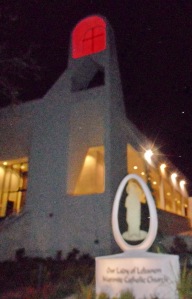
The interior of the church reflects the austere monastic sensibilities of St. Maron, the 5th Century Lebanese monk who shaped this Syriac-Antiochian rite Catholic Church.

Prior to the accent lights being turned on, the design was stark and aesthetically challenging for me. Even with the lights on, the altar is surprisingly barren for the most important feast of the liturgical year for Christians. There were a few lillies at the foot of the main altar and there was a floral display on the East Apse which also served as the Empty Tomb for the Easter Vigil.
Note the tree stump at the foot of the altar, that is used as a stand for the veneration of the Cross. Perhaps it harkens back to the Cedars of Lebanon, which is an important symbol amongst Maronite Catholics.

This is the Clergy approaching the altar for the beginning of the Qurbono (Divine Liturgy). Note the Chorbishop in the center who's vestment has a cross with the Cedar of Lebanon.
The Liturgy was conducted in Syriac as well as English. The hymns that were sung were in Aramaic which was impossible for me to read. Aramaic was Jesus' native tongue so it sounded like what the followers of "The Way" would have sung in the 1st Century A.D.
There were some unusual aspects of this Easter Vigil. There was incense but no use of Holy Water or candles. The Maronite Church tends to baptize their Catachumens on the Feast of the Epiphany in January. Candles are not as import of an symbol at the Easter Vigil, as the Maronite Church breaks fast on noon of Great Saturday during the simple "Awaited Light" ceremony. This may explain why there is not pent up anticipation for the Easter Vigil as observed amongst the Maronites.
It was remarkable how much this Liturgy celebrating the Resurrection emphasized the Glorious Cross. The Chorbishop made prayers on the four corners of the altar with the processional cross, as if to proclaim the hope of the resurrection to all the Earth. The faithful were invited to venerate the Glorified Cross as they received Communion.
Another interesting Easter feature of this vigil Qurbono was the emphasis on the Empty Tomb. As the faithful departed from the Divine Liturgy, they were given flowers from the Empty Tomb as well as an Easter Egg.

Despite the alternating languages during the Liturgy, it was not challenging to follow. The order of the Liturgy is different, as the Prayers of the Faithful are offered in the middle of the Liturgy of the Eucharist. In addition, the sign of peace is passed along from the altar to the congregation by youthful altar servers.
For me, the Maronite Qurbono was the most exotic of my Holy Week experiences. Unfortunately, I found the Easter Vigil at Our Lady of Lebanon to be anti-climatic and personally unsatisfying. That being said, I was intrigued by proclaiming the glory of the cross to the four corners of the Earth. In addition, I was touched by the post resurrection highlighting of the Empty Tomb as well as receiving the Easter souvenirs.

The interior of the church reflects the austere monastic sensibilities of St. Maron, the 5th Century Lebanese monk who shaped this Syriac-Antiochian rite Catholic Church.
Prior to the accent lights being turned on, the design was stark and aesthetically challenging for me. Even with the lights on, the altar is surprisingly barren for the most important feast of the liturgical year for Christians. There were a few lillies at the foot of the main altar and there was a floral display on the East Apse which also served as the Empty Tomb for the Easter Vigil.
Note the tree stump at the foot of the altar, that is used as a stand for the veneration of the Cross. Perhaps it harkens back to the Cedars of Lebanon, which is an important symbol amongst Maronite Catholics.
This is the Clergy approaching the altar for the beginning of the Qurbono (Divine Liturgy). Note the Chorbishop in the center who's vestment has a cross with the Cedar of Lebanon.
The Liturgy was conducted in Syriac as well as English. The hymns that were sung were in Aramaic which was impossible for me to read. Aramaic was Jesus' native tongue so it sounded like what the followers of "The Way" would have sung in the 1st Century A.D.
There were some unusual aspects of this Easter Vigil. There was incense but no use of Holy Water or candles. The Maronite Church tends to baptize their Catachumens on the Feast of the Epiphany in January. Candles are not as import of an symbol at the Easter Vigil, as the Maronite Church breaks fast on noon of Great Saturday during the simple "Awaited Light" ceremony. This may explain why there is not pent up anticipation for the Easter Vigil as observed amongst the Maronites.
It was remarkable how much this Liturgy celebrating the Resurrection emphasized the Glorious Cross. The Chorbishop made prayers on the four corners of the altar with the processional cross, as if to proclaim the hope of the resurrection to all the Earth. The faithful were invited to venerate the Glorified Cross as they received Communion.
Another interesting Easter feature of this vigil Qurbono was the emphasis on the Empty Tomb. As the faithful departed from the Divine Liturgy, they were given flowers from the Empty Tomb as well as an Easter Egg.
Despite the alternating languages during the Liturgy, it was not challenging to follow. The order of the Liturgy is different, as the Prayers of the Faithful are offered in the middle of the Liturgy of the Eucharist. In addition, the sign of peace is passed along from the altar to the congregation by youthful altar servers.
For me, the Maronite Qurbono was the most exotic of my Holy Week experiences. Unfortunately, I found the Easter Vigil at Our Lady of Lebanon to be anti-climatic and personally unsatisfying. That being said, I was intrigued by proclaiming the glory of the cross to the four corners of the Earth. In addition, I was touched by the post resurrection highlighting of the Empty Tomb as well as receiving the Easter souvenirs.
Star Wars Easter Eggs

Off the Mark Peanuts Easter Basket

It almost seems like the Easter Beagle had something off the mark at Woodstock (sic).
Christ Has Risen!

Many Christian cultures, particularly in the Eastern churches, acknowledge this miraculous gift from God with the greeting "Christ has risen! -Indeed, He is Risen!"
Subscribe to:
Posts (Atom)