

Showing posts with label St. Faustina Kowalska. Show all posts
Showing posts with label St. Faustina Kowalska. Show all posts
Sunday, April 8, 2018

Sunday, April 23, 2017

Thursday, February 9, 2017
BOOK REVIEW: Churchy by Sarah Condon

Churchy [Mockingbird 2016 180 p.] is a non-fictional version of chick lit which shares Sarah Condon’s unvarnished personal vignettes that seeks to lead readers towards retrospective religious reflections. It is published by Mockingbird Ministries, which strives to connect the Christian faith with the realities of everyday life in fresh down-to-earth ways. No one will mistake Sarah Condon’s Churchy musings as mundane faith history.
 |
| "St." Flannery O'Connor |
Condon is an Episcopal priest who is married to another Episcopal priest pastoring a parish in Houston Texas. Sarah Condon’s ministry has included hospital ministry, in the dreaded “Liver Floor” filled with alcoholic patients in need of organ donations.
 |
| Rev. Sarah Condon |
Since my Roman Catholic tradition neither has many married clergymen (much less priestesses), I was interested in understanding her vocation as well as appreciating the strains of family life with clerical duties. Honestly, this angle was not clear. Most of Churchy seemed drawn from the lens of a Churchy mother who was wont to extrapolate theological truths from the quotidian.
Condon’s view on her vocation was not crystal clear. In the introduction, she noted that:
“Josh [her husband] and I are both Episcopal priests. But most Sundays, you will see me in the pews with my children. On occasion, I stand behind the altar and celebrate communion.”
As someone who understands sacramentality as a key distinction between the laity and the ordained, it seemed like a nonchalant approach to take a priestly vocation yet to only feel obliged to “stand behind the altar” from time to time.
Regarding her role as an off hours hospital chaplain, Condon conceded that she often hears the awkward inquiry: “What do you do for a living?” She modestly asserts that she utters a ratio 70%-30% stupid to wise things while “bumbling around” hospital wards. This underplays the vital mission of just being present to those who may be on the precipice of death. Such companioning in Christ echoes tenants of Ignatian spirituality which Pope Francis has been championing during his papacy.
In the chapter which contains the Cereal Aisle Stranger section, Sarah Condon wrote:
“And there is the issue of me telling strangers what my husband and I do for a living while standing in front of a row of Fruit Loops.”

Kind of surreal small talk in the Cereal Section. Yet the way that Sarah described the query as being about what they did for a living rather than refer to their priestly vocations or ministries. That particular turn of phrase niggled at me.
Condon’s later reflections on her household concluded:
“Meanwhile, I bring in some income with writing and part-time ministry work, put food in the crock pot, spend an incredible amount of time with my children and talk on the phone to my mom, a lot.”
Sarah’s description of her role is a dose of honesty mixed in with a good measure of self-deprecating humor. However, it begs a poignant question –Should ordination be deemed just a part time job or a vocation of sacerdotal service to the people of God? It is certainly unusual for a priest to be married to a priest while raising a family. I again wonder about how there can be sufficient self sacrifice to the needs of the faithful. Can active priests really be part-timers?
Irregardless of that dialectic, Sarah Condon does not easily fit into feminist stereotypes. In reflecting on her early attitudes towards her marriage that:
“[I]t was easier to think of myself as a woman liberated from role of ‘wife’ than it was to think of myself as a co-signer in covenant of sickness and health.”
That liberated attitude along with being a priest being married to a priest might lead one to believe that Condon had totally signed unto the feminist agenda. Yet Condon rues the Episcopal Church’s expectation that of a feminist art installation as a spiritual superhero who be both a real mother as well as a mother in ministry. Sarah also chaffed at feeling as if women priests are figuratively shoved through male shaped boxes, as exemplified as being required to complete an ordination exam as she was in the midst of a first trimester miscarriage.
Condon does work in some theological concepts in layman’s terms. She jars her readers attention with the theological precept that: “Humanity is a clown parade of jackwagons.” Her vivid illustration of low anthropology contrasted with high Christology. This highlights how God loves us flawed sinful men and women but his only Son redeemed us through his Cross and resurrection. She also explores how “If your boss thinks you’re awesome then you’ll become awesome” has a nexus with the imputed righteousness of Christ.
There were two poignant thoughts which I gleaned from Sarah Condon’s Churchy self-reflections. As she was being shadowed as a hospital chaplain, she was ministering to a family who had decided to withdraw life support for a dying loved one. Condon wondered why her mentor returned to the terminal patient’s room and whispered consoling phrases into her ear. That taught her that she was at the most important time in a person’s life–the deathbed. Moreover, Condon noted that hearing is the last sense to go, so it is always worth whispering love into the ears of the dying. It called to mind St. Faustina Kowalska’s recommendation to pray the Divine Mercy Chaplet at a death bed.
The other striking idea Condon borrowed from her friend's bon mot. While at a ecumenical pastors meeting in New York City, they were discussing which were their "target audiences" for planting ministries. Many participants suggested going after youth groups. But her friend puckishly suggested: “We’d like to get more middle-aged divorced women”, which underlined the need to minister to the broken-hearted. This vision sees church as a field hospital tending to those wounded and suffering from life’s battles.
While I suspect that I was not part of Churchy’s “target audience”, I can appreciate how Sarah Condon’s witty writing desultory anecdotes and contemporizing gospel lessons might inspire a modern metanoia. To wit, Lady Gaga sought Rev. Sarah Condon to hear her preach before performing at the Houston Super Bowl.

Sarah Condon should be commended for writing Churchy as an honest soul searching book as well as expressing a willingness to see God in all things.
Sunday, April 3, 2016

Sunday, April 12, 2015
St. Faustina Kowalska on Suffering
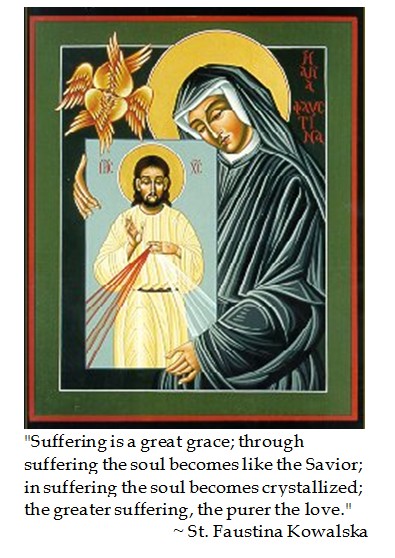
The day that he was elected to fill the Chair of St. Peter, Pope Benedict XVI spoke about Pope St. John Paul II's devotion to the Divine Mercy:
"We listen with joy to the proclamation of the year of mercy... Jesus Christ is divine mercy in person. To find Christ means to find the mercy of God...The day of vengeance and the year of favor coincide in the paschal mystery, in Christ, dead and risen. This is the vengeance of God: He himself, in the person of the Son, suffered for us. The more we are touched by the mercy of the Lord, the more we are in solidarity with his suffering, the more disposed we are to complete in our flesh 'what is lacking in Christ's afflictions'."
This message of divine mercy was echoed throughout Pope Benedict's papacy.
Thursday, April 24, 2014
Considering the Heroic Virtues of Pope St. John Paul II

At his
funeral in St. Peter's Square in 2005, there were prolonged chants from the
multitude gathered for “Santo Subito” (Sainthood Now!). On April 27, 2014, the Catholic Church celebrated the canonization of the 264th pontiff Pope St. John Paul II
(born Karol Józef Wojtyła) along
with the 262nd Vicar of Christ Pope St. John XXIII (ne Angelo Giuseppe
Roncalli) in St. Peter's Square in Vatican City.
 |
| Three American Presidents paying respects to Pope John Paul II, April 2005 |
Some
Protestants bristle at the notion that the Church “makes” saints, as nobody
(but Christ) is perfect and that we are all supposed to be called to sainthood
in our Christian identity. Certainly our baptism marks us as part of the
Lord’s people and calls us to holiness. The Catholic Church can
recognize, based on investigation and guidance from the Holy Spirit, that
a person is already a saint, definitely in heaven and having led a life of
great holiness that is worthy of veneration by the faithful. Canonized
saints are important examples to the faithful of how to live a heroic (not
perfect) Christian life.
Pope
John Paul II was a remarkable man who wore many hats in his life. He was a
Laborer, Thespian, Playwright, Patriot, Priest, Philologist, Philosopher,
Pilgrim, Bishop, Theologian, Sportsman, Scholar, Statesman and Vicar of Christ. The cause for John Paul II's canonization
however is not premised on doctrinal
dissertations, academic accolades or even geopolitical accomplishments.
It is about how John Paul II lived his life to reflect the Christian virtue
which still touches the faithful today.
After
several years of investigation led by postulator Monsignor Slawomir Oder, the
Vatican’s Congregation for the Causes of Saints recommended Servant of God John
Paul II’s heroic virtue to the Pope. On December 19, 2009, Pope Benedict XVI
proclaimed John Paul II as “Venerable”. The Church normally requires that
one miracle is attributable to intercessions of a Venerable, but the Vatican
only investigates possible miracles after a candidate is declared Venerable.
These miracles are almost always miraculous medical cures as these are the
easiest to verify.
 |
| Sr. Marie Simon Pierre |
After
the Congregation for the Causes of Saints scrutinized the medical evidence that
the healing was rapid, lasting and inexplicable and that is was the result of
praying for the Venerable’s intercessions to God, they made their
recommendations to the Pope. On January 14, 2011, Pope Benedict XVI
determined that the criteria were met to refer to John Paul II as “Blessed”.
Such a beatification is a formal statement from the church that it is “worthy
of belief” that a person has some to salvation but is not to be taken as a sign
that canonization is certain. Pope John Paul II was declared venerable on
May 1st, 2011.
 |
| Floribeth Mora Diaz |
It
should be noted, however, that the Pontiff can give a dispensation for the
requirement of a second miracle for sainthood, as Pope Francis did for the
cause of Pope St. John XXIII, who will share the spotlight with Pope St. John
Paul II in the canonization ceremony. In
the case of Pope St. John XXIII, there were calls to make him "Santo
Subito" too in 1962 , as well as at the end of the end of Vatican II in
1965, but the Church has waited until today to accord canonization.
The
date of the canonization may well have been chosen because it was the
2nd Sunday of Easter, which Pope John Paul II instituted during his Papacy
as “Divine Mercy Sunday”, due to his Devotion to St. Faustina Kowalska
(1905-1938). The vigil mass of the feast of Divine Mercy had just been
celebrated at John Paul II’s bedside when he fell into a coma and soon after
died.
 |
| Pope John Paul II at Auschwitz (1979) |
As a
Pole, Karol Wojtyła was shaped by victimization by totalitarian domination,
first by the Nazi’s then by the Communists. We rightly remember the
suffering of several million Jews being interned and murdered as part of the
Holocaust of World War II, but Nazi Germany intended to eradicate any ‘deviant”
culture, which also included non-Aryan intellectuals, Slavs, Catholics, gypsies
and homosexuals. The Nazi closing of Polish Universities came as Polish
intellectuals were being slaughtered. During the Nazi occupation, Polish
culture was systematically being eradicated and the Slavs being treated as
slaves for the Reich.
After
the Nazi’s invaded Poland, Jagiellonian University was closed and all able
bodied males were conscribed to labor to avoid deportation to Germany. So
the young Karol Wojtyła worked as a limestone quarryman and in a chemical
plant. But the way that
Karol Wojtyła reacted to these events was answering the call to the priesthood
clandestinely and by participating in Rhapsodic Theater, a clandestine company
dedicated to preserve some measure of Polish culture. The group’s concentration
on the interplay of personal relationships and the power of the human word had
a profound impact on how Karol Wojtyła lived his faith under the domination of
the communists and as Pope. John Paul II fought against his ideological
adversaries with the power of the word, sublime yet suggestive symbolism and
fostering a sense of connection and community.
After the Second World War, Poland suffered under the
domination of Stalinist inspired Communism, which sought to reshape humanity
into a Godless existence where the average worker was no more than a cog in the
machine. The communists built Nowa Huta (“New Steel Mill”) on the eastern outskirts of
Krakow in 1947 as a Socialist Realist worker’s paradise with everything but a
church. The faithful kept erecting crosses which communist officials would tear
down. Eventually the piety of Poles caused the people to want a church to
be built, but the atheistic state first refused, then reluctantly agreed to
quell unrest only to renege on the understanding and then crush any
dissent.
 |
| Arka Pana in Nowa Huta, Poland |
 |
| Crucifix at Arka Pana, Nowa Huta Poland |
 Then Cardinal Karol Wojtyła was elected Pontiff in
October 1977 during the Year of Three Popes. While Pope John Paul II was
the first non-Italian pope in 454 years and was from a nation behind the Iron
Curtain, he was chosen because of his theology. John Paul II chose as his
papal motto “Totus Tuus”, which reflected his Reflected his personal
consecration to Mary which was based on the spiritual approach of St. Louis de
Montfort (1673-1716)—“Totus
tuus ego sum, et omnia mea tua sunt"
("I am all yours, and all that I have is yours"). In Crossingthe Threshold of Hope, he explained that
the “Totus Tuus” motto expressed the understanding that he “[c]ould not exclude
the Lord's Mother from my life without neglecting the will of God-Trinity”. Polish born composer Henryk Gorecki (1933-2010) wrote the choral
piece “Totus
Tuus” in honor of Pope John Paul II’s
3rd visit to Poland in 1987.
Then Cardinal Karol Wojtyła was elected Pontiff in
October 1977 during the Year of Three Popes. While Pope John Paul II was
the first non-Italian pope in 454 years and was from a nation behind the Iron
Curtain, he was chosen because of his theology. John Paul II chose as his
papal motto “Totus Tuus”, which reflected his Reflected his personal
consecration to Mary which was based on the spiritual approach of St. Louis de
Montfort (1673-1716)—“Totus
tuus ego sum, et omnia mea tua sunt"
("I am all yours, and all that I have is yours"). In Crossingthe Threshold of Hope, he explained that
the “Totus Tuus” motto expressed the understanding that he “[c]ould not exclude
the Lord's Mother from my life without neglecting the will of God-Trinity”. Polish born composer Henryk Gorecki (1933-2010) wrote the choral
piece “Totus
Tuus” in honor of Pope John Paul II’s
3rd visit to Poland in 1987.
From the start of his Petrine ministry until his eventual
death from Parkinson’s Disease 26 ½ years later, John Paul II’s message to the
faithful was the Lucan exhortation “Be not afraid”. In fact, John
Paul II uttered the phrase three times during his homily at the Papal Inauguration. This message “Be not afraid… open the door wide
to Christ” was chosen as the slogan for his beatification.
It was the same message that he brought when he first visited his homeland of Poland in June 1979. The documentary Nine Days That Changed the World showed the power that John Paul II message of “Be not afraid” had with the Polish people to instill the dignity of the individual to live out their faith and, with the guidance of the Holy Spirit, renew the face of the Earth and their land.
It was the same message that he brought when he first visited his homeland of Poland in June 1979. The documentary Nine Days That Changed the World showed the power that John Paul II message of “Be not afraid” had with the Polish people to instill the dignity of the individual to live out their faith and, with the guidance of the Holy Spirit, renew the face of the Earth and their land.
 The millions of Poles who flocked to their favorite
son's first pilgrimage back to his homeland showed that the faithful were not
alone in that officially atheistic state and served as a real retort to Stalin’s taunt of “The Pope! How man divisions does he got?"
Both LechWalesa, the piously Catholic worker who lead
the Solidarity movement (and eventually became Poland’s President), and Vaclav Havel, the less spiritual leader of a free Czechoslovakia,
credit the fall of the Iron Curtain to the message “Be not afraid” embodied in
John Paul II’s 1st visit to Poland.
The millions of Poles who flocked to their favorite
son's first pilgrimage back to his homeland showed that the faithful were not
alone in that officially atheistic state and served as a real retort to Stalin’s taunt of “The Pope! How man divisions does he got?"
Both LechWalesa, the piously Catholic worker who lead
the Solidarity movement (and eventually became Poland’s President), and Vaclav Havel, the less spiritual leader of a free Czechoslovakia,
credit the fall of the Iron Curtain to the message “Be not afraid” embodied in
John Paul II’s 1st visit to Poland.
On May 13, 1981, Pope John Paul II was shot four times at close range and critically
wounded in St. Peter’s Square by Mehmet Ali Ağca, a trained Turkish gunman. Many belief
that this assassination attempt was a hit job coordinated by the Bulgarian
Secret Police with the complicity of the Kremlin. Yet less than two and a
half years later, John Paul II met with Mehmet Ali Ağca and forgave the gunman on Christmas, 1983.
 |
| [L] Pope John Paul II shot May 13, 1981, [R] Pope forgives Agca December 25, 1983 |
Pope St . John Paul II was convinced that Our Lady of
Fatima kept him alive during the ordeal where he lost 3/4ths of his blood.
TheThird Secret of our Lady of Fatima can be
seen as predicting the assassination attempt on the Pope. The John Paul II’s
faith filled connection between his assassination attempt and the visions of
Fatima that a bullet from his wounds now tops the golden finery of the Our Lady
of Fatima processional statue.
One of
the hallmarks of Pope St. John Paul II’s reign was being a Pilgrim as Vicar of
Christ to proclaim Jesus as the Redeemer of Humanity to all the Earth. Frankly,
he came pretty close to covering it all. It is speculated that the curia
spent about a fourth of their time planning for and executing his 104 foreign
trips to 125 countries which totaled 725,000 miles. While John Paul
certainly visited countries with large Catholic populations many times, he also
visited places which had no discernible Christian populations. John Paul
II not only sought to evangelize for Christ, he wanted to foster interfaith
dialog. For example, in the wake of the September 2001 terrorist attacks on
America, John Paul II kept his planned itinerary to Kazahkstan, which is mostly
Muslim nation.
 At the
behest of Pope St. John Paul II, World Youth Days were held every couple of
years at rotating international locations. Skeptics certainly questioned in
disengaged youth would care about such events, but the youth loved to rally
around the Pope and open themselves to the new evangelization. The
vitality of World Youth Day tradition has not subsided in the loss of
John Paul II. These large conclaves of young people meeting to renew
their faithful inclinations echoes how John Paul II loved to channel the energy
of crowds in a positive manner to allow people to feel connected in a vibrant
and visceral way.
At the
behest of Pope St. John Paul II, World Youth Days were held every couple of
years at rotating international locations. Skeptics certainly questioned in
disengaged youth would care about such events, but the youth loved to rally
around the Pope and open themselves to the new evangelization. The
vitality of World Youth Day tradition has not subsided in the loss of
John Paul II. These large conclaves of young people meeting to renew
their faithful inclinations echoes how John Paul II loved to channel the energy
of crowds in a positive manner to allow people to feel connected in a vibrant
and visceral way.
The message of “Be not afraid” was epitomized by Pope
John Paul II’s reaction to a musical gift when he visited Los Angeles in
1987. To demonstrate courage,Tony Melendez, a musician without hands played a guitar song with his
feet. John Paul II was so moved by the performance that he leaped off the
main stage to embrace Melendez on the satellite stage. John Paul II’s
spontaneous and evocative human gesture along with his message of how courage
gives hope to all continues to touch the faithful..
While Pope Benedict XVI did not formally recognize John
Paul II as a martyr in his beatification mass, many feel that the manner
in which John Paul II lived with his debilitating disease and how he died with
dignity in the Vatican was exemplary. His final words were uttered in Polish "Allow me to depart to the house of the Father". John Paul II had run the good race
and was not afraid to go home to the Father by extending his life through
extraordinary medical procedures for terminal illness.
In addition, Pope St. John Paul II left a large body of theology during his long pontificate, which will have a long lasting influence upon the Church. These writings centered on phenomology and personalism. His encyclicals considered Christ the Redeemer, morality in the Splendor of Truth, Mariology in Mother of the Redeemer, the Gospel of Life, and Faith and Reason. Many feel that Pope St. John Paul II will be best remembered for his "Theology of the Body", which was based on 129 lectures from his Wednesday audiences, which focused on Christian marriage, celibacy and virginity, contraception and the sacrament of marriage.
The liturgical feast day for Blessed John Paul II will be
October 22nd. In the Liturgy of the Hours for that day is part of the
Papal Inauguration "Do not be afraid" homily. The prayer for
that day in the Office of Readings is:
O God, who are rich in mercy and who willed that the blessed
John Paul the Second should preside as Pope over your universal Church, grant,
we pray, that instructed by his teaching, we may open our hearts to the saving
grace of Christ, the sole Redeemer of mankind. Who lives and reigns.
In Washington DC, the new seminary has dedicated to the now Pope St. John Paul II.
The John Paul II Cultural Center in Washington DC has been converted into a
Church and Shrine and will be rechristened the "St. John Paul II National Shrine".
Pope
St. John Paul II's example of the new evangelization, his example of
forgiveness and fearlessness for standing up for the faith certainly gives the
model to “Be
Not Afraid” in our own paths toward being part of the Community of Saints.

Sunday, April 7, 2013

Sunday, April 15, 2012

Subscribe to:
Posts (Atom)